This article examines the provided image as a historically grounded archaeological reconstruction of a high-status domestic interior from southern Mesopotamia, situated within the cultural and aesthetic horizon of the Early Dynastic III period (circa 2600–2350 BCE), broadly aligned with the era of the First Dynasty of Ur. Seen through this lens, the image emerges as an authentic Mesopotamian interior reconstruction—a carefully composed synthesis in which archaeology, material culture, and sacred domestic order converge within the lived space of an elite Early Dynastic household.
Reconstructing an Elite Mesopotamian Domestic Interior
The image should be understood not as a literal depiction of a single excavated house, but as a carefully composed synthesis drawing from multiple archaeological sites, material studies, and scholarly reconstructions, intended to convey cultural accuracy rather than photographic exactness. Although the term “the first Uruk people” is sometimes used in popular discourse, it is important to clarify that the Uruk Period predates the First Dynasty of Ur by several centuries.
Yet history is rarely divided by clean lines. The architectural ideas, symbolic language, and material intelligence developed during the Uruk Expansion formed the foundation upon which Early Dynastic society was built. What we see in this interior is therefore not Uruk itself, but its legacy—refined, domesticated, and woven into everyday life during the third millennium BCE.
Material Intelligence in Early Dynastic Households
The Theology of Mud
The architecture of this space begins with the most fundamental truth of Mesopotamia: the theology of mud. In a land shaped by alluvial plains, where stone was scarce and timber precious, civilization quite literally rose from earth and water.
The thick mudbrick walls, coated in hand-applied plaster, are not merely structural solutions but climatic and psychological ones. Their mass absorbs heat by day and releases it slowly by night, creating an interior that feels enclosed, protective, and cool—a sanctuary against the relentless sun. The subtle irregularities in the plaster surface quietly reveal the human hand behind the construction, grounding the space in labor rather than abstraction.
A Tactile Dialogue of Materials
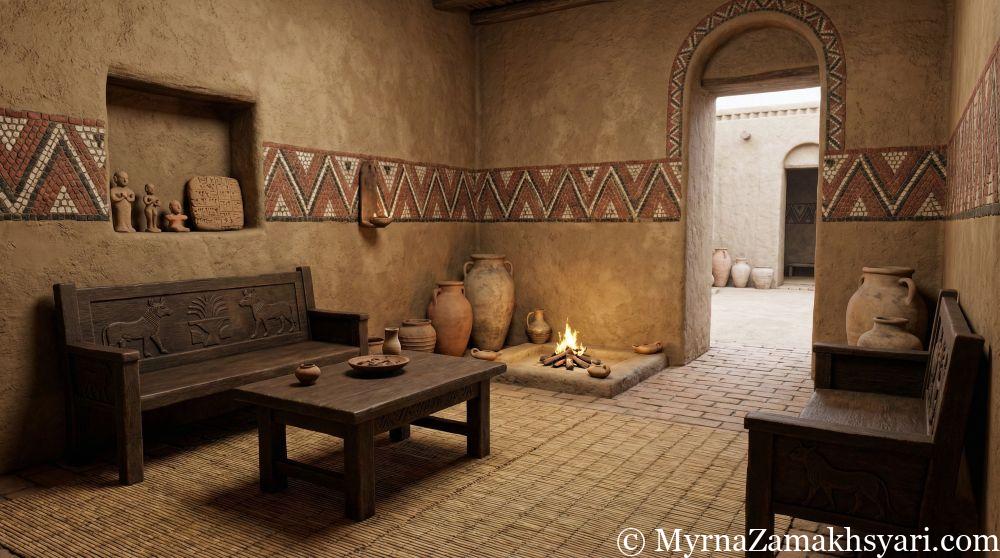
An arched doorway opens toward a sunlit courtyard, marking a significant architectural threshold. The true arch, still a sophisticated feature in this period, reflects technical knowledge inherited from earlier monumental architecture in Uruk and Eridu. Its presence within a domestic setting suggests wealth, status, and an understanding of spatial transition: from the shadowed intimacy of the home to the communal openness of the courtyard, where daily life unfolded under the sky.
The floor combines baked brick with woven reed mats, a pairing that speaks both of economy and intelligence. Fired brick required fuel and labor, making it a costly material typically reserved for elite spaces or areas exposed to moisture. Reed matting, drawn from the marshlands of southern Mesopotamia, softens the earthen surface beneathfoot while providing insulation. Together, they form a tactile dialogue between permanence and impermanence, between earth hardened by fire and fibers renewed by seasonal harvest.
Domestic Space as Sacred Architecture
Cosmic Order in Geometry
One of the most striking visual elements in the room is the geometric cone mosaic frieze running along the upper walls. This decorative technique originated in the Late Uruk period, most famously adorning temple facades within the Eanna precinct. Thousands of small clay cones, their tips dipped in mineral pigments—red ochre, bitumen black, and natural clay tones—were pressed into wet plaster to create rhythmic patterns of zigzags and triangles.
Transplanted from sacred architecture into a domestic interior, the frieze carries powerful implications. It represents the migration of cosmic order from temple to home, suggesting that sacred structure did not belong solely to gods, but could envelop daily human life.
The zigzag motif, in particular, holds deep symbolic resonance. In Sumerian visual language it commonly signifies water, the source of life and the domain of the god Enki, as well as distant mountains from which rivers descend. Repeated endlessly, these patterns were believed to serve an apotropaic function. By imposing symmetry and repetition, they were thought to confuse or entrap chaotic forces, transforming the walls themselves into a quiet form of spiritual defense.
Symbols of Wealth and Devotion
The furnishings reinforce the elite status of the household. Heavy wooden benches and tables, carved from dark imported timber, signal wealth in a region where quality wood had to be transported from far-off mountain ranges. Carved into the furniture are stylized bovine figures—bulls or oxen—symbols of strength, fertility, and divine authority in Sumerian cosmology. Associated with major deities such as An and Enlil, the bull embodies stability and abundance. To sit upon such imagery was to align the household with agricultural prosperity and cosmic order.
At the heart of the room lies the open hearth, both practical and symbolic. It provides warmth, light, and a place for food preparation, but it also carries sacred meaning. Fire, associated with deities such as Gibil or Nusku, was understood as a purifying force and a mediator between worlds. The rising smoke bridged earth and sky, transforming an ordinary domestic act into a subtle ritual.
Set into the wall, a recessed niche serves as a household shrine. This feature reflects the deeply personal nature of Mesopotamian spirituality, where devotion was woven into daily routine. Small votive figurines stand within the niche, their hands clasped and eyes wide. These figures do not represent gods, but rather the family members themselves, rendered as perpetual worshippers. Through them, the household maintained an unbroken gaze toward the divine, ensuring continued favor even in moments of absence or distraction.
Light, Shadow, and Memory
Beside the figurines rests a clay cuneiform tablet, a quiet yet profound object. Literacy in this period was rare and specialized. The tablet signals the homeowner’s connection to the administrative machinery of the city-state—perhaps as a scribe, merchant, or official. It embodies the essence of the urban revolution: the belief that order, memory, and power could be preserved in marks pressed into clay.
The visual atmosphere of the room is defined by an earthbound palette shaped entirely by natural materials. Ochres, reddish-browns, bitumen blacks, and muted reed tones dominate the space. Light enters dramatically, flickering from the hearth and pouring in from the courtyard entrance. This contrast between illumination and shadow creates a psychological landscape where the center of human activity is safe and visible, while the corners remain dim and enigmatic. In this interplay, ancient ideas resurface: light as order and protection, darkness as the realm of uncertainty.
Taken as a whole, this interior offers a compelling portrait of elite urban life during the First Dynasty of Ur. It is a space where environmental pragmatism, social hierarchy, and spiritual belief converge seamlessly. Every surface and object serves both a practical purpose and a metaphysical one, reflecting a culture that did not separate the sacred from the everyday. In this room, the city, the cosmos, and the household breathe as one.