Neo-Babylonian Lustral Bathroom — Design Synthesis Case Study
This master bathroom transcends its functional role and emerges as a contemporary lustral chamber—a space where cleansing is understood not merely as hygiene, but as ritual. Rooted in Neo-Classical architectural discipline and infused with Neo-Babylonian symbolic language, the interior transforms the act of bathing into a meditative encounter with order, memory, and renewal. Rather than replicating ancient forms, the design translates Mesopotamian cosmology into a modern architectural experience that feels deliberate, legible, and profoundly calm.
At its structural core, the room is governed by strict bilateral symmetry.
Water, Cleansing, and the Mesopotamian Understanding of the Body
In ancient Mesopotamia, water was never understood as a neutral resource. It was a sacred medium, closely associated with the god Enki (Ea), whose domain—the apsū—represented the primordial waters beneath the earth from which life, wisdom, and cosmic order emerged. Archaeological and textual sources indicate that bodily cleansing functioned as a ritual act rather than a purely hygienic one. Ablutions were performed to remove ritual impurity, prepare the body for prayer, healing rites, divination, or moments of spiritual transition. While Mesopotamian homes did not contain bathrooms in the modern sense, water was deliberately introduced into domestic and sacred contexts as a tool for purification and restoration.
This design consciously translates that ancient understanding into a contemporary interior. By framing bathing as a ritualized experience rather than a cosmetic routine, the space reclaims water as a symbolic agent. The act of bathing here mirrors ancient lustration practices, where physical cleansing was inseparable from psychological and spiritual renewal. The bathroom thus becomes a modern interpretation of a purification chamber—private, contained, and intentionally ordered.
Walls, niches, palms, and lighting elements align along a central axis, producing an immediate psychological effect of equilibrium. This spatial order echoes ancient ceremonial spaces, where symmetry was employed to communicate permanence and divine balance. In a private setting, this same principle generates a sense of protection and inward focus. The body, placed at the center of this geometry, becomes momentarily still—mirroring the ancient belief that order in space could restore order within the self.
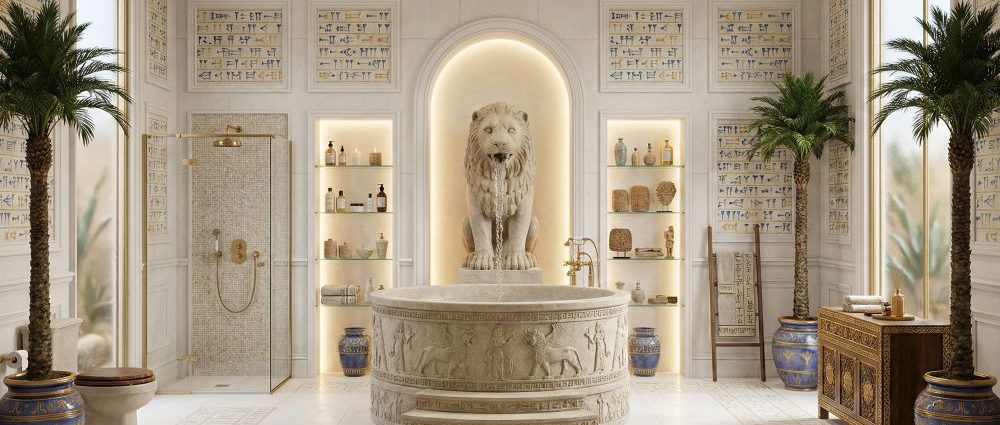
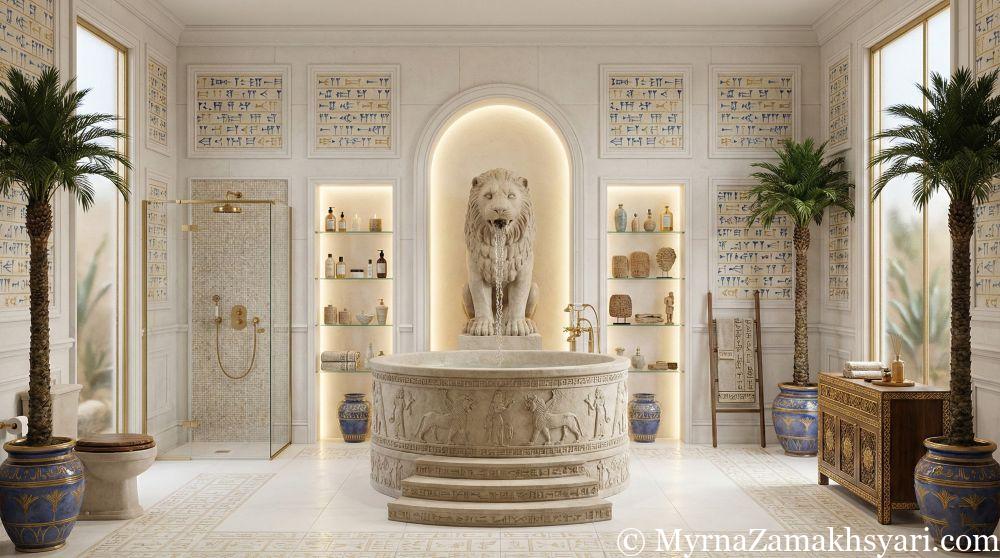
The symbolic heart of the room is the Lion of Babylon fountain, positioned within a softly illuminated recessed arch.
The Circle as Protection: Interpreting the Round Basin
The circular form of the freestanding tub is a deliberate departure from linear or rectilinear bathing fixtures. Historically, circular geometry carried deep symbolic meaning across ancient cosmologies, including Mesopotamia. The circle represented continuity, enclosure, and the absence of hierarchy—there is no front or back, no privileged direction. In the context of water and purification, this geometry reinforces the idea of cyclical renewal rather than linear progression.
Although no archaeological evidence suggests the presence of modern bathtubs in ancient Mesopotamia, the symbolic logic of the circle aligns closely with Mesopotamian conceptions of water and the apsū as boundless and without edge. By situating the body within a round basin, the design creates a psychological enclosure, placing the bather at the center of a calm, uninterrupted field. This spatial decision supports a sense of safety and inward focus, echoing the ancient belief that order in form could restore balance within the self.
In Mesopotamian archaeology, the lion was the sacred animal of Ishtar, embodying both royal authority and apotropaic power. Here, the lion functions as a guardian rather than a spectacle. Carved from pale stone and rendered with restrained realism, it releases a continuous stream of water into the circular freestanding tub below. The gesture recalls ancient water sanctuaries and purification rites connected to the apsū—the primordial subterranean waters believed to be the source of wisdom, creation, and cosmic order.
The tub itself acts as a narrative vessel. Its carved reliefs depict winged lamassu and figures clothed in kaunakes, the tiered wool garments associated with early Mesopotamian elites. These figures do not assert dominance; instead, they form a symbolic perimeter, suggesting that the bather is enclosed within a ring of protection and ancestral presence. The circular geometry reinforces this idea, eliminating sharp corners and creating a sense of continuous flow—both spatially and psychologically.
The walls function as a vertical archive.
The Absence of Mirrors and the Rejection of the Performative Self
One of the most striking decisions in this bathroom is what has been intentionally omitted: the mirror. In contemporary interiors, mirrors often dominate bathing spaces, reinforcing self-surveillance and visual evaluation. In contrast, Mesopotamian ritual culture placed little emphasis on visual self-reflection. Polished reflective surfaces existed, but they were rare and not central to purification practices.
By excluding mirrors, the design redirects attention away from appearance and toward sensation, presence, and internal state. The body is not treated as an object to be observed, but as a participant in ritual. This absence aligns with the historical logic of lustration, where purification was understood as a transformation of condition rather than image. Psychologically, the removal of reflective surfaces reduces cognitive distraction, allowing the space to function as a zone of quiet introspection rather than performance.
Framed panels of cuneiform script are set against deep lapis lazuli blue and gold leaf, invoking the celestial symbolism of the ancient world. Historically, lapis lazuli was associated with the heavens and divine favor, its rarity amplifying its spiritual value. By integrating the world’s earliest writing system into the architectural envelope, the design implies that knowledge, memory, and language are as fundamental to dwelling as shelter itself. These panels are carefully proportioned and evenly spaced, allowing their intensity to resonate without overwhelming the room.
Surrounding this symbolic density, the white stone walls operate as a visual and psychological counterbalance. Their cool tone and smooth texture introduce a museum-like clarity, preventing the space from becoming excessive or theatrical. Light reflects gently across these surfaces, emphasizing material quality over ornament. This restraint ensures that symbolism remains legible and contemplative rather than decorative.
Biophilic elements are integrated with equal discipline. Tall date palms, housed in cobalt-and-gold vessels, stand symmetrically on either side of the central axis. In Mesopotamian culture, the date palm symbolized life, fertility, and sustained abundance—an essential companion to water in an arid landscape. Here, the palms function as living columns, softening the stone architecture and reintroducing organic rhythm into the space. Their presence subtly reinforces the cyclical relationship between body, nature, and ritual.
Modern luxury is expressed through precision rather than excess. Brushed gold fixtures echo the sacred color language of antiquity while maintaining contemporary refinement. The glass-enclosed shower, minimalist in form, incorporates fine mosaic tiles that capture and refract light, adding a sense of weightlessness. This contrast between heavy stone symbolism and transparent modern technology creates a psychological balance—anchoring the space in history while affirming present-day comfort.
Architectural Foundations: The Neo-Classical Frame
Beneath its dense symbolic language, the architectural skeleton of this bathroom is firmly Neo-Classical. The discipline of symmetry, proportion, and axial order acts as a stabilizing force, ensuring that the accumulation of ancient references never tips into visual excess. The room is organized along a clear central axis, radiating outward from the circular bathtub and lion fountain. This compositional strategy recalls the spatial logic of temples and ceremonial chambers, where order itself was a form of meaning.
The recessed arch behind the lion fountain is a pivotal architectural gesture. While the Romans later perfected the structural arch, its symbolic and monumental use was already present in Mesopotamian gateways such as the Ishtar Gate. Here, the arch functions as both frame and threshold, separating the everyday world from the ritual core of the space. Clean lines, honed white stone, and restrained moldings provide a contemporary clarity that allows historical elements to remain legible rather than overwhelming.
The Centerpiece: The Lion of Babylon
At the heart of the room stands the Lion of Babylon fountain, the most overtly symbolic element of the design. Drawing from the iconography of the processional ways of Babylon, the lion serves as an apotropaic guardian. In Mesopotamian belief, lions were sacred to Ishtar, embodying power, protection, and royal authority. Their presence was meant not to intimidate, but to guard thresholds and sanctified spaces.
The circular freestanding tub beneath the lion functions as a contemporary reinterpretation of a lustral basin. While modern in form, its symbolic role aligns with ancient purification vessels associated with the apsū. The bas-relief carvings that wrap its exterior—depicting winged lamassu and figures clad in kaunakes—establish a protective perimeter. Archaeologically, the kaunakes, a layered wool garment, was closely associated with elite status and ritual propriety in early Mesopotamia. Its depiction here subtly reinforces the notion of royal presence and devotional dignity, suggesting that the space operates not merely as a private bath, but as a chamber aligned with the symbolic codes of kingship and reverence before the gods. These motifs suggest that even in moments of privacy, the body remains symbolically enclosed by guardianship and ancestral order.
Surface Details and Iconography
The room’s surfaces operate as a curated archive of ancient visual language. Framed panels of cuneiform script transform the world’s earliest writing system into architectural ornament, bridging the divide between museum artifact and domestic interior. Rather than serving as literal text, these inscriptions function as symbols of memory, law, and recorded presence.
Lapis lazuli accents appear in planters and vessels, their deep blue tones historically associated with the heavens and divine favor. Paired with gold detailing, these colors recall the sacred palette of Babylonian monumental architecture. Along the floor and the base of the tub, geometric borders and lotus motifs subtly guide movement toward the bath, evoking the idea of a ceremonial path. These details reinforce the sense that approach and arrival are integral parts of the spatial experience.
Materials and Color Palette
The atmosphere of luxury in this space arises not from excess, but from contrast. Pale stone surfaces—reminiscent of alabaster and limestone used in Near Eastern palaces—establish a calm, luminous foundation. Against this backdrop, brushed gold and brass fixtures introduce warmth and precision, translating ancient symbolism into contemporary refinement.
Biophilic elements play a crucial balancing role. The symmetrical placement of date palms references their status as Trees of Life in Mesopotamian culture, while also softening the weight of stone and metal. Their presence reconnects the ritual of bathing to cycles of growth, fertility, and renewal that were central to ancient worldviews.
Modern Integration and Functional Continuity
Despite its archaeological depth, the bathroom remains fully contemporary in function. A minimalist glass-enclosed shower introduces transparency and lightness, its subtle mosaic tiles reflecting illumination without competing with the tub’s symbolic gravity. Storage is integrated through a dark wood vanity with gold inlay, echoing the craftsmanship of luxury furnishings from the Royal Tombs of Ur. This element operates simultaneously as functional cabinetry and sculptural object, reinforcing the room’s identity as both lived space and curated environment.
Design Synthesis and Contemporary Interpretation
As a whole, the Neo-Babylonian Lustral Bathroom exemplifies design synthesis at its most refined. It demonstrates how ancient cosmology, archaeological symbolism, and classical spatial discipline can inform a modern interior without becoming literal or nostalgic. The result is a private sanctuary that honors the body as both physical and symbolic—where cleansing becomes continuity, and where the rituals of daily life are elevated through architecture, memory, and measured restraint.