"History remembers the kings who built the walls.
Myth remembers the silence buried beneath them."
"These recovered fragments speak of the Listeners—
those who stood at the threshold of civilization
and were asked to leave
so that the city could begin."
Recovered fragments attributed to the early years of the First Dynasty.
Catalog Entry
Catalog Entry: AP-001
Origin: Lower Mesopotamia, attributed to the pre-wall era of Ur.
Status: Apocryphal / Suppressed.
The Silence That Founded Ur
Fragment I — Before the First Crown
Before the city had walls,
it had a silence older than stone.
The elders did not speak of it openly.
They said silence was not meant to be named,
only endured.
To name it, they warned,
was to ask it to remain.
[The elders refused to name this. The word used here is disputed.]
But some of us heard it anyway.
Not as a voice,
not as a command,
but as a pressure beneath the breath—
as if the earth itself were listening
before it allowed itself to be shaped.
We were not priests.
We were not kings.
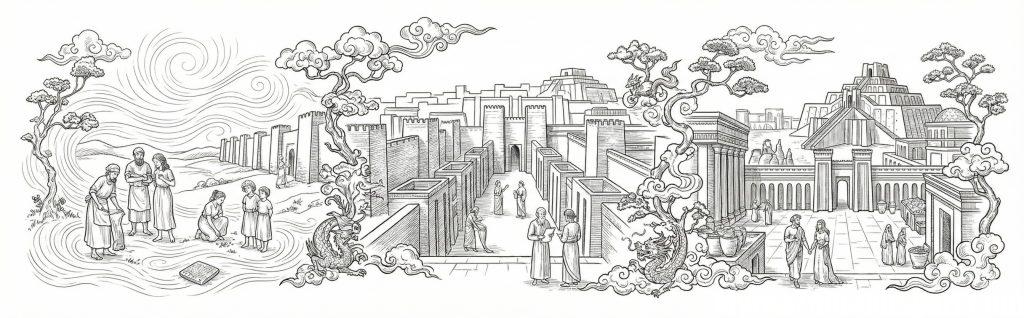
We were bakers who woke too early,
women who paused mid-weave,
children who forgot the end of their dreams.
The silence found us
before the city found its name.
Before the first crown was raised,
before Ur was spoken as a promise,
we knew the ground was not empty.
It remembered something
that had not yet happened.
They called us Listeners later,
when they needed a word to remove us by.
[Listeners is not the term used in the first copy.]
We did not worship what we heard.
We did not understand it.
We only knew this:
Not everything that wishes to be built
should endure.
When the first king was chosen,
the silence was brought before the council—
not in chains,
not in ritual,
but in absence.
A tablet was turned face-down.
A song was interrupted.
A child was told never to repeat a certain lullaby.
The city rose.
And the silence was asked to leave.
It did not.
It settled instead
between the stones,
beneath the thresholds,
inside the places where names are forgotten
before they are spoken.
This fragment ends here.
The remainder was never copied.
Or perhaps it was,
and no one dared to keep it.
Fragment II — The Listeners
They lived among the city before it understood itself.
They were not marked by rank or robe. No seal bore their names. They were known only by the way they paused—hands lingering above dough, fingers hesitating in the act of weaving, eyes lifting when the wind shifted without cause.
The Listeners learned early that what they heard could not be spoken plainly. Words hardened it. Names gave it weight. So they learned to speak around it, the way one walks around a sleeping child.
In the mornings, they listened while drawing water. At night, they listened through walls too thin to hold silence. They learned which streets echoed too long, which thresholds hummed faintly at dusk. Some refused to sleep facing the river. Others never sang again.
Children noticed them first.
Children said they smelled of rain that had not yet fallen. Children said the Listeners stood still when the ground sighed. Children stopped asking questions when their parents lowered their voices.
No law forbade the Listeners. Not at first.
Instead, small corrections appeared.
A bread recipe was altered. A stair was rebuilt with one step fewer. A prayer was shortened so it ended before the final breath. Each change was minor. Each was necessary, the elders said, to keep the city aligned.
The Listeners understood the truth before the council did:
the city was learning how to forget.
Some of them left. Some disappeared into the outer fields where no walls yet stood. Others stayed, because listening is not a skill one can set down.
They did not resist when their names were no longer recorded.
They had already learned that erasure begins long before the mark is removed.
Fragment III — The Decision
No record remains of the day the decision was made.
[No decree survives. This absence is intentional.]
This is not an absence of preservation.
It is an absence by design.
What survives are gestures.
A council chamber swept clean before dawn. A tablet turned face-down and placed against the wall. A scribe instructed to stop midway through a sentence and never return to it.
There was no decree declaring the end of listening. Such clarity would have required acknowledgment.
Instead, the elders agreed—quietly, unanimously—that the city could not continue to hear itself.
They said the ground spoke too often. They said the wind lingered too long at certain corners. They said the people had begun to hesitate.
Hesitation, they warned, was the enemy of permanence.
So the measures were practical.
Walls were thickened. Courtyards were narrowed. Stone was layered to dull resonance. Houses were oriented away from the places that breathed.
The Listeners were not accused.
They were simply no longer consulted.
When one spoke of a street that should not be paved, the matter was postponed. When another warned of a gate that should remain unsealed, the concern was noted and set aside.
Silence was not banished.
It was managed.
That night, the first crown was placed upon a waiting head.
The city exhaled.
Something beneath it did not.
Fragment IV — After the Silence
Ur stood.
Its walls held. Its granaries filled. Its name traveled farther than its people.
The chronicles speak of prosperity, of order, of the long line that followed the first crown. They speak of stone that endured and laws that remained.
They do not speak of the spaces that never settled.
There were rooms where lamps refused to stay lit. Corridors where footsteps softened without cause. Corners where dust never quite rested.
Children born after the silence learned not to pause mid-song. They learned to finish their sentences. They learned not to ask why certain alleys were closed without record.
The Listeners were gone by then, or indistinguishable from anyone else.
Yet sometimes, in the deepest hours before dawn, the city still listened.
Not openly. Not fully.
Only enough to remember that something had once been asked to leave and had chosen instead to remain.
The stones remembered what the chronicles did not.
Ur endured.
But it never heard itself again.
[Nothing follows. This is not a loss of text.]