"No street in the city leads where it first appears to go. Arrival is never direct.

The city ensures that nothing arrives unchanged."
Recovered apocryphal text based on architectural patterns observed in early Mesopotamian urban settlements.
Catalog Entry
Catalog Entry: AP-002
Attributed Region: Southern Mesopotamia
Period: Early urban phase (pre-monumental standardization)
Status: Apocryphal / Observational / Unresolved
No ordinance survives regarding the layout of streets.
The pattern, however, repeats.
Streets That Do Not Lead
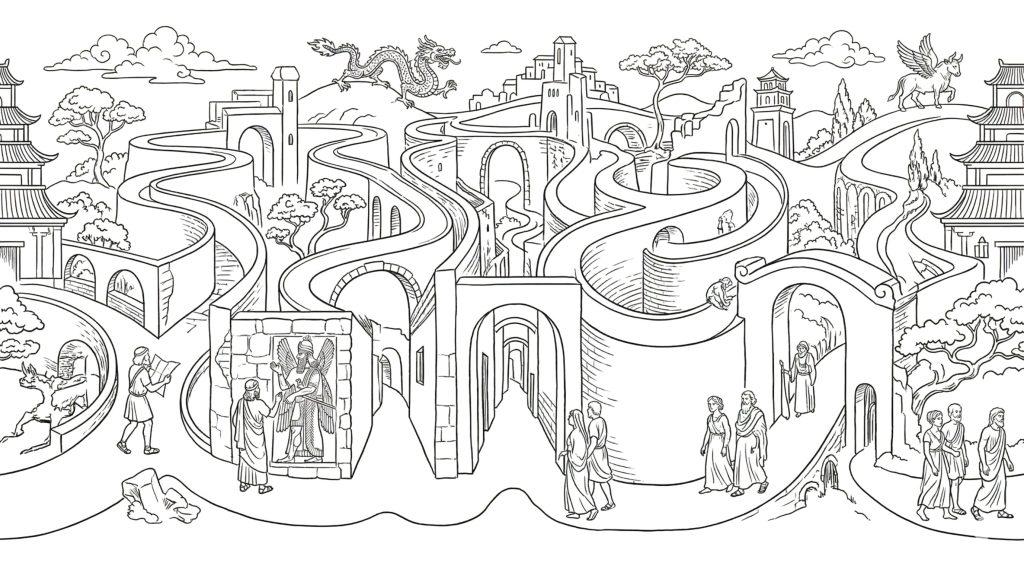
No street in the city leads where it first appears to go.
This is not immediately noticeable. The city does not resist entry, nor does it announce confusion. One may walk for some time before realizing that progress has been slowed without obstruction.
The turns are gentle. Rarely abrupt. Each corner feels reasonable—almost considerate. A wall curves where one expects it might. A passage narrows only after the body has committed to it.
The city does not block movement. It revises it.
Those unfamiliar with the city assume inefficiency. They blame age, erosion, or the absence of planning. Yet the pattern persists across quarters, generations, rebuildings. Streets are repaired as they were. Corners are restored at the same angles. Detours survive renovations.
What appears accidental proves durable.
The city is not difficult to navigate. One can learn its habits. One can arrive eventually. But arrival is never direct. Every path contains a delay that feels intentional only after it has been endured.
There are no straight corridors that carry a body from edge to center. No avenue offers the satisfaction of uninterrupted passage. Each approach is softened by deflection, as though momentum itself were considered impolite.
Movement becomes incremental. The walker adjusts. Pace slows. Attention sharpens.
In time, one learns not to ask where a street leads, but what it allows.
The elders never explained this arrangement. Builders left no justification. No map records the intent. Yet the city continues to guide bodies away from haste, away from certainty, away from clean arrival.
Some say the streets were shaped to confuse invaders. This explanation satisfies only those who have never tried to move quickly from within.
Confusion is not the effect.
Delay is.
A body delayed is a body observed.
Those who walk the city often report the same sensation: the feeling of being slightly out of step with one’s own purpose, as if intention itself has begun to lag behind the body. Plans lose their urgency not all at once, but in fragments—first the certainty, then the need, then the reason for haste. Destinations loosen their hold, names fading into impressions, impressions into mere directions taken out of habit.
Some swear they have walked for hours only to arrive again at the place they first departed, though the streets felt unfamiliar at every turn. Others recall the opposite: believing themselves still far from their destination, they suddenly find the desired street beneath their feet, reached without any memory of having approached it.
At dusk, a few encounter a dead end where none was marked—a blank wall bearing the relief of Marduk’s gaze, stone carved with calm authority. By morning, along the same route, the passage opens again, the wall absent, as if it had never interrupted the way.
The city offers no resistance. It does not bar the way or demand retreat. It simply places a pause inside the walker, a soft delay that feels almost merciful, until reconsideration no longer feels imposed, but chosen.
Some leave the city uncertain whether they ever truly arrived anywhere at all.
There are places one cannot reach without passing elsewhere first. There are turns that feel like forgetting. There are moments when the city seems to ask—quietly—whether the journey is still desired.
No signage interrupts the walk. No authority questions passage. The city does not forbid movement.
It simply ensures that nothing arrives unchanged.
Those born within the city do not notice this at first. They learn the rhythm early. Their sense of distance is calibrated differently. What others call delay, they call normal time.
Children run the curves without complaint. Deliveries arrive late but intact. Messages soften before they reach their recipients.
Only visitors remark upon the wandering.
Only those who intend to move quickly feel the weight of the turns.
It is said—by no one officially—that the city was built this way because straight paths remember too much. That direct passage allows intentions to remain intact. That speed preserves purpose.
The streets do not confirm this.
They only continue to bend.
When asked how to reach the river, residents gesture vaguely. Directions are offered in landmarks rather than lines. The walk takes longer than expected. The river appears suddenly, without ceremony.
No street announces it.
No axis honors it.
The city does not guide the body toward water.
It allows discovery, but not approach.
Those who study the layout remark upon its coherence. This is not chaos. It is consistency without explanation. A system that refuses to declare its logic.
The streets lead everywhere.
Just never directly.
The remainder of this text shows signs of repetition. Several passages appear to have been walked more than once.
Structural Note
This entry is considered part of a developing apocryphal sequence:
- AP-001 — The Silence That Founded Ur (the city learns not to listen)
- AP-002 — Streets That Do Not Lead (the city learns to delay)
- AP-003 — Thresholds That Were Thickened (the city learns to filter)
- AP-004 — Rooms That Remained Empty (the city learns to hold absence)
Sequence attribution remains speculative.