This article explores Early Dynastic Mesopotamian kitchens as both architectural spaces and designed systems, shaped by material limits, climate, and social order. Situated within the Early Dynastic period of southern Mesopotamia (c. 2600–2350 BCE), the kitchen emerges not merely as a functional room, but as a spatial expression shaped by climate, material limits, social hierarchy, and an intuitive understanding of workflow. Through historically plausible reconstructions of elite and commoner kitchens, this study bridges archaeological evidence with architectural thinking, revealing how some of the earliest urban interiors were already governed by principles that continue to inform spatial design today.
The interiors discussed here should not be understood as literal replicas of single excavated kitchens. Rather, they are synthesized reconstructions informed by archaeological reports, material studies, and comparative domestic evidence from sites such as Ur, Nippur, and Lagash. Their purpose is not photographic exactness, but spatial clarity—allowing us to read how these kitchens were built, used, and inhabited.
The Kitchen as Built Reality: Architecture, Material, and Use
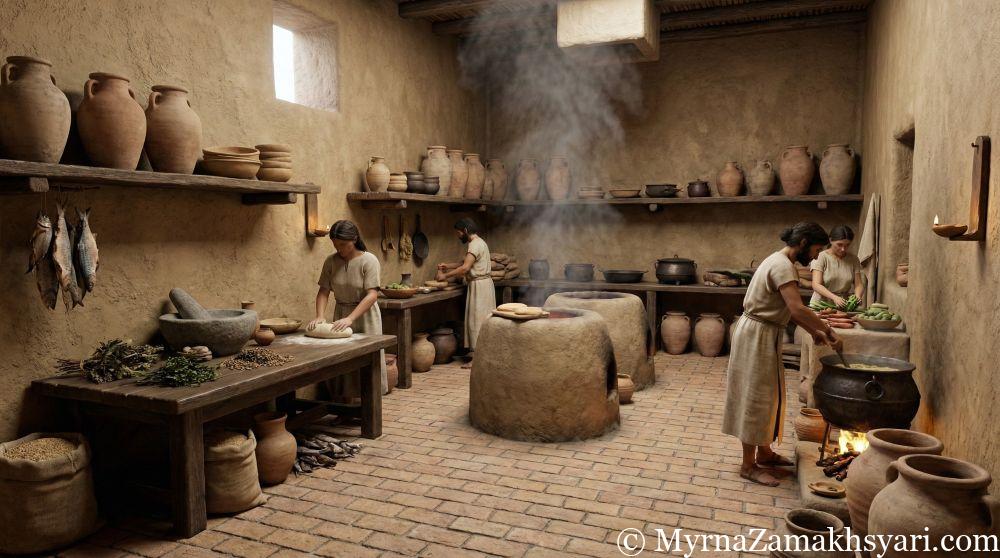
In Early Dynastic Mesopotamia, architecture was inseparable from the landscape. Kitchens, like all domestic spaces, were constructed primarily from mudbrick, a material drawn directly from the alluvial plains. Thick walls coated in earthen plaster provided thermal mass, moderating interior temperatures in a region defined by extreme heat. Floors varied according to status and function. In elite households, baked brick was used to create durable, cleanable surfaces suitable for intensive daily labor. In more modest homes, packed earth floors fulfilled the same role through simplicity and repairability.
Elite kitchens were conceived as dedicated rooms within large courtyard houses. Their scale alone signals intention. High ceilings, generous floor area, and fixed architectural installations indicate a space designed for sustained production rather than occasional use. Light and ventilation were carefully managed through high-set openings, allowing smoke to escape while maintaining enclosure and privacy. These kitchens were not peripheral; they were infrastructural cores of the household.
At the center of elite kitchens stood large cylindrical clay ovens known as tannurs. Anchored directly into the floor, these ovens established the spatial hierarchy of the room. Their size and number suggest the preparation of bread on a significant scale, sufficient to feed extended families, servants, and guests. Above them, smoke hoods and ventilation shafts demonstrate an early architectural response to heat and airflow—evidence that environmental control was already an understood design concern.
Storage was integrated into the architecture itself. Large ceramic jars lined walls and niches, transforming vertical surfaces into functional boundaries. Dried fish, herbs, and produce hung from beams, creating layered zones of use without the need for partitions. Work areas were defined not by walls, but by habitual movement: kneading near preparation tables, grinding at stone mortars, boiling over open fire pits. Space was organized through action.
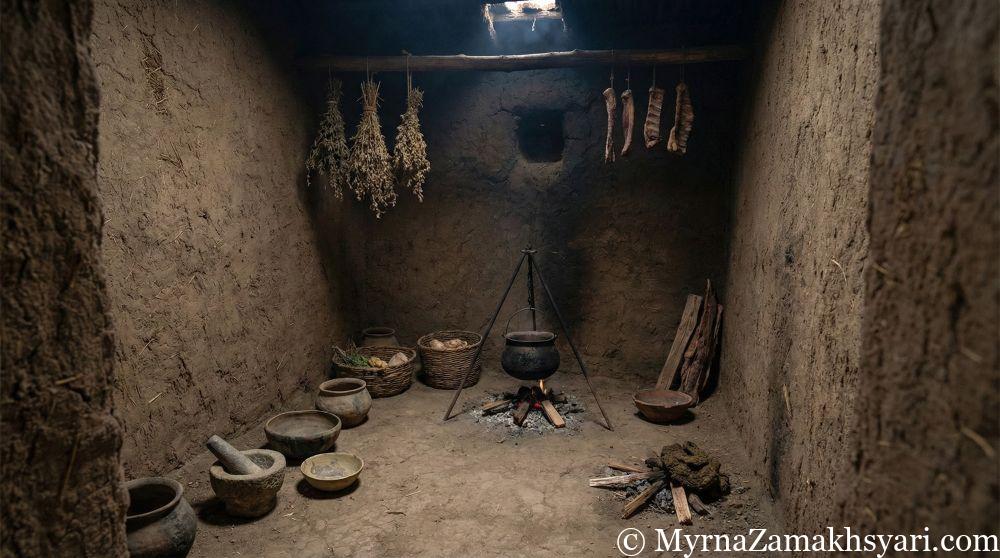
Commoner kitchens followed the same material logic but expressed it through constraint. Smaller in scale and often multifunctional, these spaces were defined by immediacy. Rough mudbrick walls and packed earth floors allowed for quick repair and adaptation. Light, ventilation, and smoke release were combined into a single roof opening, collapsing multiple architectural needs into one gesture.
Cooking took place over a simple floor hearth, typically supporting a single suspended pot. This arrangement minimized material investment while maintaining flexibility. Storage was limited to baskets, small ceramic vessels, and hanging bundles of preserved food. Fuel sources—often dried animal dung in the absence of timber—were stored nearby, directly shaping spatial arrangement and circulation. Despite their simplicity, these kitchens were efficient, legible, and resilient, optimized for daily survival.
The Kitchen as Designed System: Workflow, Zoning, and Spatial Intelligence
Beyond their archaeological form, these kitchens reveal an underlying logic of design. Elite kitchens functioned as operational systems. Multiple heat sources allowed parallel tasks to occur simultaneously, reducing bottlenecks and increasing output. Preparation surfaces, ovens, storage, and waste areas were positioned to minimize unnecessary movement. This was zoning without drawings—design embedded in routine.
Verticality played a crucial role. Walls were not passive enclosures but active participants in storage and organization. Hanging provisions, stacked jars, and elevated shelves extended the usable volume of the room while preserving clear circulation paths. The result was a spatial economy that balanced abundance with order.
In commoner kitchens, design intelligence expressed itself through compression rather than expansion. Short circulation paths reduced effort. Objects were few but multifunctional. The absence of fixed installations allowed the space to adapt constantly, responding to season, fuel availability, and household size. Here, efficiency was not achieved through scale, but through clarity.
Taken together, these two kitchens demonstrate that design is always a reflection of access—access to material, labor, time, and surplus. In Early Dynastic Mesopotamia, social hierarchy was written directly into spatial form. The elite kitchen externalized abundance through specialization and scale. The commoner kitchen internalized constraint through adaptability and concentration.
Design Before Design Theory
Long before architectural theory was formalized, the Mesopotamian kitchen already embodied principles familiar to contemporary designers: workflow optimization, zoning by function, environmental responsiveness, and material honesty. These spaces remind us that design does not begin with aesthetics, but with necessity. It emerges wherever humans negotiate between resources, climate, and daily life.
In reading these ancient kitchens as both architecture and system, we are invited to reconsider the continuity of spatial thinking across time. What survives in mudbrick and ash is not only evidence of how people cooked, but of how they understood space itself. The kitchen, humble yet essential, stands as one of humanity’s earliest design laboratories—where form followed life, and space learned to serve it.