How four small funerary vessels reveal the ancient Egyptian vision of the body, protection, and eternal life.
Four Silent Vessels Behind Glass
In the quiet light of a museum gallery, canopic jars often appear smaller than imagination expects.
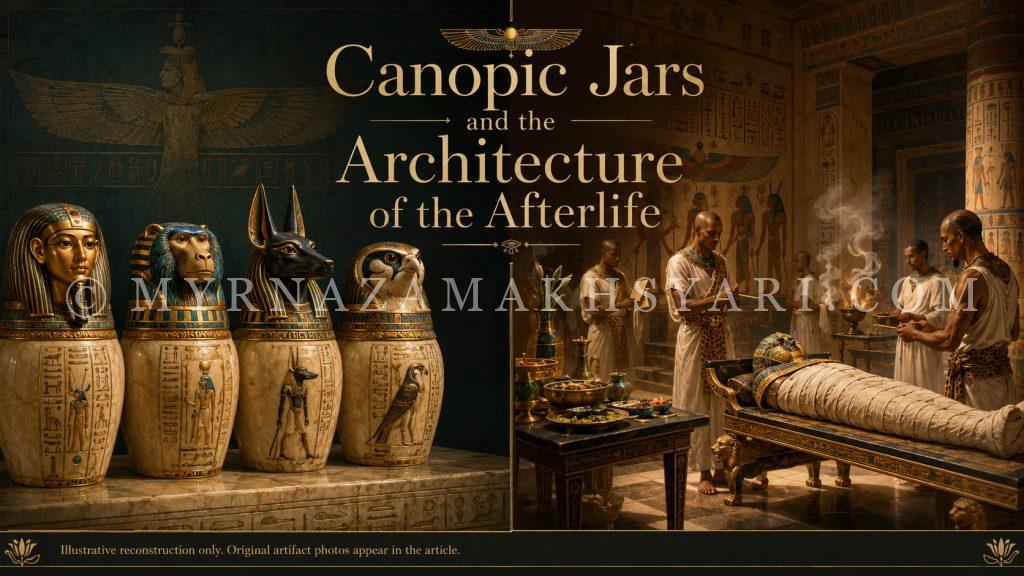
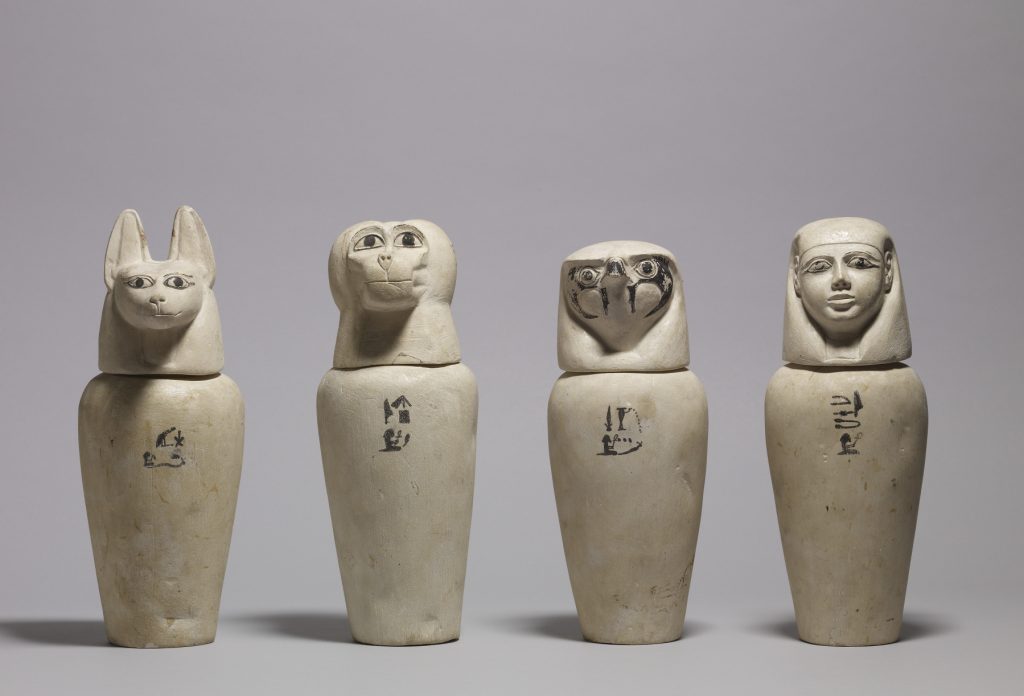
They stand behind glass: four vessels, four lids, four faces watching across centuries. A human head. A baboon. A jackal. A falcon. To the hurried visitor, they may seem like beautiful containers from a civilization obsessed with death. But to the ancient Egyptians, these jars were never mere objects. They belonged to a much larger architecture—one built not only with stone, wood, linen, and resin, but with theology, memory, protection, and hope.
A canopic jar was a chamber for what the body could not lose.
It held the organs removed during mummification: the liver, lungs, stomach, and intestines. These were not discarded remains, nor clinical specimens, nor symbolic decorations placed in a tomb for atmosphere. They were part of the person. They had to be preserved, guarded, named, and ritually placed within the sacred order of the burial.
To understand canopic jars, then, we must first step beyond the object itself. We must enter the ancient Egyptian imagination of death—not as an end, but as a dangerous passage. The tomb was not only a grave. The coffin was not only a box. The mummy was not only a body. And the jars were not only containers.
Together, they formed an architecture of the afterlife.
Why the Body Had to Survive Death
For the ancient Egyptians, a human being was not made of flesh alone.
A person was a constellation of visible and invisible elements: the physical body, the heart, the name, the shadow, the ka, and the ba. These parts did not simply vanish at death. They entered a fragile condition. They could be separated, endangered, forgotten, or restored. Funerary ritual existed to protect that fragile transition, allowing the deceased to become whole again in the next world.
The body was central to this hope.
Modern eyes may look at mummification and see an extreme effort to prevent decay. But in ancient Egyptian belief, preservation was not only biological. It was spiritual architecture. The body served as an anchor for identity. It allowed the ka to receive offerings. It allowed the ba to recognize and return to the person. It gave the deceased a continued form through which existence could be renewed.
This is why the body was treated with such solemn care. It was washed, dried, anointed, wrapped, named, protected, and surrounded with objects that could assist its passage. The tomb became a dwelling. The coffin became a protective shell. Amulets became guardians. Spells became roads. Images became provisions. And the canopic jars became sacred chambers for the inner body.
The heart held a special place in this system. Unlike the liver, lungs, stomach, and intestines, the heart was usually left inside the body. To the ancient Egyptians, the heart was not only an organ of life. It was the seat of intelligence, memory, feeling, and moral responsibility. In the judgment after death, the heart could testify for or against its owner.
Before Osiris, in the Hall of the Two Truths, the heart was weighed against Maat—truth, justice, balance, and the proper order of the cosmos. A life lived in harmony with Maat opened the way to blessed existence. A heart burdened with wrongdoing could mean annihilation, the terrifying second death.
This is why Egyptian funerary practice was so carefully layered. Death was not a simple doorway. It was a trial, a journey, a transformation. The deceased needed a preserved body, a protected name, a truthful heart, ritual knowledge, divine assistance, and the right architecture of passage.
Canopic jars belonged to that sacred system.
They guarded the organs so the person could remain complete.
What Were Canopic Jars?
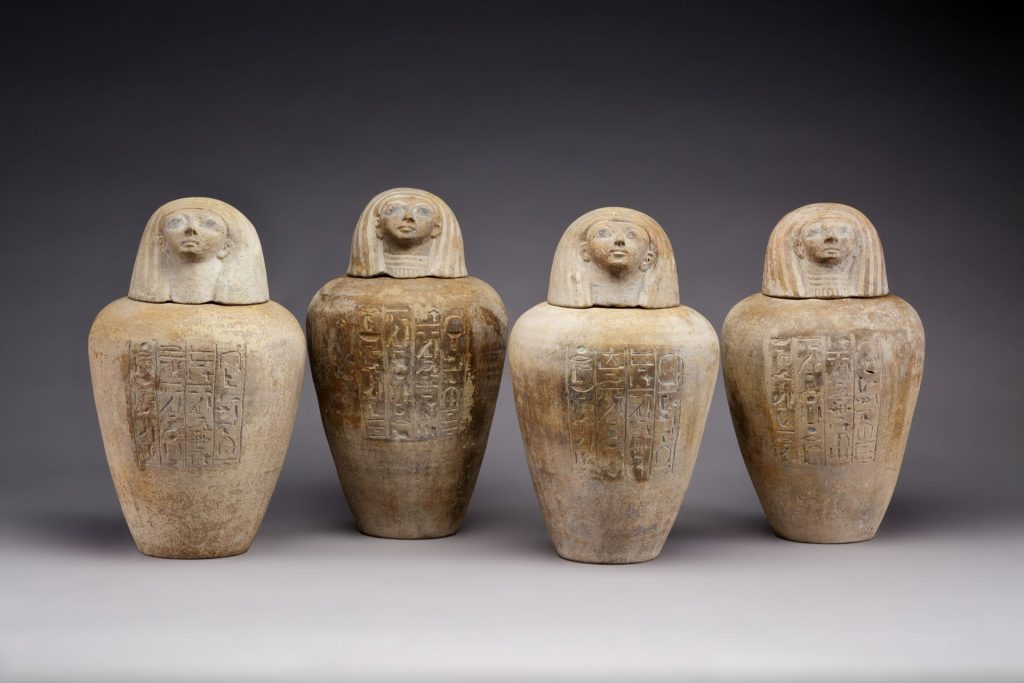
Canopic jars were funerary vessels used in ancient Egyptian mummification to preserve the internal organs removed from the body.
During the embalming process, the lungs, liver, stomach, and intestines were taken out, treated, wrapped, and placed under divine protection. These organs mattered because the deceased was expected to continue living in the afterlife. The afterlife was not imagined as a purely abstract spiritual condition. It was a renewed existence, one in which the dead might breathe, eat, receive offerings, travel, speak, and dwell among gods and blessed beings.
The jars themselves changed over time. Some early forms had simple lids. Later examples developed human-headed stoppers. By the New Kingdom and later periods, the best-known form appeared: four jars whose lids represented the Four Sons of Horus, divine guardians of the organs.
Their materials varied. Some were made of limestone, alabaster, calcite, wood, pottery, or faience-like materials. Some were beautifully carved and painted. Some bore inscriptions naming the deceased and invoking divine protection. Others were simpler, rougher, or symbolic. Their quality depended on period, region, wealth, and the ritual resources available to the family.
In their most elaborate form, canopic jars were not modest containers. They were crafted objects of care. Their bodies were vessels; their lids were faces; their inscriptions were prayers. They transformed vulnerable organs into protected sacred matter.
A modern museum may display them as individual artworks, each standing quietly under controlled light. But in their original setting, they belonged to a larger funerary environment. They were part of the tomb, part of the mummy’s protection, part of the deceased’s hope to remain whole beyond death.
They were small architectures for the inner life.
The Four Sons of Horus: Guardians of the Inner Body
The most famous canopic jars are guarded by the Four Sons of Horus.
Each son protected one organ. Each had a recognizable head. Each was linked to a divine function in the preservation of the deceased.
Imseti, with a human head, protected the liver.
Hapy, with a baboon head, protected the lungs.
Duamutef, with a jackal head, protected the stomach.
Qebehsenuef, with a falcon head, protected the intestines.
This system gave the inner body a sacred order. The organs were not placed randomly into containers. They were assigned guardians. They were made legible within a divine pattern. The body was divided, but not abandoned. It was separated so it could be preserved; preserved so it could be protected; protected so it could be restored.
The animal-headed lids also carried deep symbolic force. A visitor today may admire them as sculptural forms, but in their ancient context, these heads were not decorative masks. They were presences. They marked the vessel as protected territory. They announced that the organ inside had not been left alone in death.
Here, canopic jars reveal one of the most powerful qualities of Egyptian funerary thought: nothing vulnerable should remain unguarded.
The liver had a guardian.
The lungs had a guardian.
The stomach had a guardian.
The intestines had a guardian.
Even the hidden interior of the body was given divine company.
The Canopic Chest: A Small Architecture of Protection
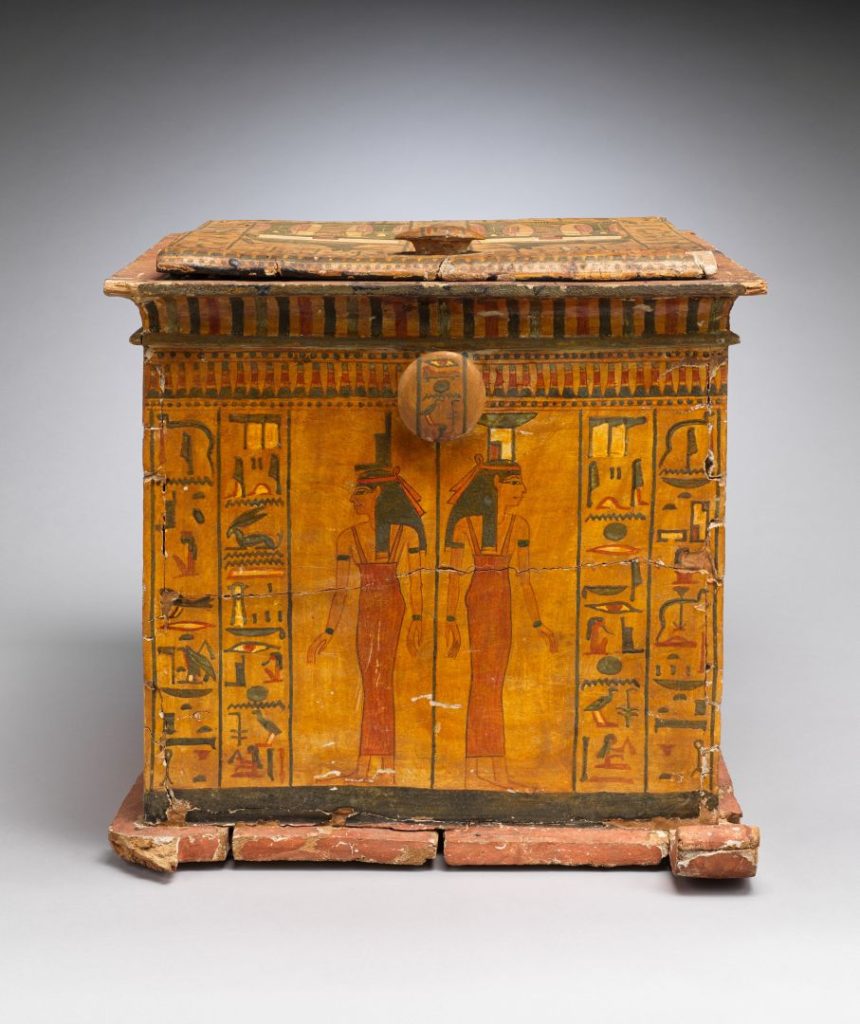
Canopic jars were often placed inside a canopic chest or box.
This is where the word “architecture” becomes more than metaphor. The jars were not only made; they were housed. They were arranged in compartments. They were enclosed, sealed, and surrounded by images and inscriptions. The canopic chest became a miniature shrine, a sacred container for containers.
Some canopic boxes were divided into four compartments, one for each jar and organ. Their decoration could include protective goddesses such as Isis, Nephthys, Neith, and Selket, often associated with the Four Sons of Horus. In other examples, the chest might resemble a shrine, complete with architectural details such as a cavetto cornice, a lid, and sledge-like runners.
This layering matters.
The organ was placed inside a jar.
The jar was placed inside a chest.
The chest was placed inside a tomb.
The tomb was placed within the sacred landscape of death and memory.
Protection unfolded like nested chambers.
To look at a canopic chest is to see how the Egyptians thought spatially about eternity. The afterlife was not prepared through belief alone. It was organized through placement. The body had its coffin. The organs had their jars. The jars had their chest. The deceased had a tomb. The tomb had inscriptions, images, offerings, and ritual pathways.
Death was given rooms.
And within those rooms, every part of the person was expected to find its way back into order.
When the Jar Became Symbol
Over time, the function of canopic jars changed.
In some later periods, the internal organs were preserved, wrapped, and returned to the body rather than stored inside hollow jars. Yet canopic jars continued to appear in tombs. Some were solid. Some had no real cavity. Some had lids that could not be removed. These are often described as “dummy” canopic jars.
At first, this may seem strange. Why include a jar that no longer performs its practical function?
The answer lies in the power of symbol.
By this stage, the jar was not only a container. It had become a ritual sign. Its presence invoked the protection of the Four Sons of Horus even when it no longer physically held the organ. The object had crossed from function into sacred representation. It was no longer needed as storage, but it was still needed as meaning.
This tells us something essential about Egyptian funerary imagination. Material objects did not operate only through physical usefulness. They worked through form, image, inscription, placement, and ritual association. A jar could be empty and still powerful. A lid could be symbolic and still protective. A solid object could still call upon a divine guardian.
The body’s architecture had become theological.
The jar no longer needed to hold the organ in order to hold the idea of protection.
From Museum Object to Modern Myth
Modern imagination has not always been gentle with Egyptian funerary objects.
In popular fiction, canopic jars sometimes appear as instruments of forbidden resurrection, as if preserved organs could be gathered again for a dramatic ritual that restores the dead to life. It is easy to understand why this myth is tempting. The jars already seem mysterious. They are ancient. They belong to tombs. They hold organs. They stand near mummies, spells, gods, and the shadowed theater of death.
But historically, their meaning was quieter, older, and more sacred.
Canopic jars were not theatrical devices for reviving a corpse in the modern horror-adventure sense. They were vessels of preservation and protection. They belonged to the funerary system that helped the deceased remain complete for the afterlife. Their purpose was not to stage a violent return to ordinary life, but to prepare the dead for transformed existence beyond death.
This distinction matters.
Ancient Egyptian religion did include ideas of rebirth, renewal, and continued life after death. The deceased hoped to live again, to breathe again, to receive offerings, to travel with divine beings, and to dwell in a blessed realm. But this was not the same as a cinematic resurrection ritual built around reassembling body parts for spectacle.
The canopic jar was not a prop of terror.
It was a guardian of wholeness.
Who Could Afford Eternity? Funerary Ritual, Status, and Simpler Burials
The ideal Egyptian burial could be elaborate: a carefully mummified body, painted coffins, amulets, canopic jars, funerary texts, shabti figures, offerings, tomb decoration, and rituals performed by specialists. But not every Egyptian could afford such an architecture of eternity.
Ancient Egypt was a hierarchical society. Access to funerary materials depended on wealth, status, period, region, occupation, and family resources. Royalty, high officials, priests, elite families, and the wealthy could commission more complex burials. They could pay for skilled embalmers, durable materials, decorated coffins, inscribed objects, tomb chapels, and canopic equipment.
Ordinary people often had simpler burials.
This does not mean they had no hope of the afterlife. It means their hope took humbler forms. The desire for continued existence was widespread, but its material expression was unequal. Eternity, like life, carried the marks of social difference.
Simple Burial Still Mattered
For those who could not afford elaborate embalming or expensive funerary equipment, burial itself remained meaningful.
A body could be placed in a simple grave. A few personal objects might accompany the deceased. Food, drink, amulets, beads, pottery, linen, or modest offerings could still carry protective and symbolic value. Family remembrance mattered. A spoken name mattered. A prayer mattered. The living could continue to nourish the dead through memory and offering.
The wealthy could build chapels where descendants came to commemorate them. The poor may not have left such visible monuments. Yet absence of monument does not mean absence of belief. Many ordinary people simply did not leave behind the same durable materials for museums and archaeologists to preserve.
Here, the museum’s silence must be read carefully. What survives is not always what mattered most. Stone, gold, painted wood, and inscribed papyrus endure better than a whispered prayer, a handful of grain, or a family’s grief.
The Desert as Embalmer
In earlier and simpler burials, the Egyptian landscape itself could help preserve the dead.
The dry sand of the desert naturally dehydrated bodies, slowing decay and sometimes creating natural mummies before artificial mummification became elaborate. For those who could not afford complex embalming, the hot, dry environment could serve as a kind of natural preservative.
There is something deeply moving in this.
For the elite, preservation might come through natron, linen, resin, oils, skilled hands, painted coffins, and ritual specialists. For the poor, preservation might come through sand, heat, dryness, and the earth itself.
The desert became an unadorned embalmer.
It did not carve lids in the form of gods. It did not write spells in black ink. It did not build a shrine-shaped chest. But it could still protect the body from total dissolution, giving ordinary people a simpler, harsher, yet powerful form of bodily survival.
Magical Substitution: When Image Could Become Provision
Ancient Egyptian thought gave enormous power to representation.
Images, models, written lists, carved scenes, and symbolic objects could function as more than decoration. They could become active in the afterlife. A painted offering table could provide nourishment. A model granary could become storage. A list of offerings could supply what the deceased required. A small amulet could carry a protection larger than its size.
This principle mattered especially in funerary practice.
Not everyone could afford every object in its most expensive form. But Egyptian ritual imagination allowed symbolic substitution. A representation could stand in for reality. An image could make something available. A written word could preserve a name. A small object could invoke a great power.
This does not erase inequality. It does not make a poor burial equal to a royal tomb. But it reveals a flexible religious logic: the afterlife could be furnished not only with wealth, but also with symbols.
A person might not have a richly painted tomb chapel, but a modest image, amulet, or offering formula could still participate in the sacred economy of protection.
And among all these symbolic protections, words held a special power.
For the ancient Egyptians, writing was not passive. A name written down could help a person endure. A spell inscribed on a coffin, amulet, papyrus, or mummy wrapping could guide, defend, nourish, or transform the deceased. In this sense, funerary texts belonged to the same world as images and objects: they were not merely descriptions of belief, but instruments that acted within the afterlife.
When Words Became Protection: The Book of the Dead
Few Egyptian funerary terms stir modern curiosity as quickly as Book of the Dead.
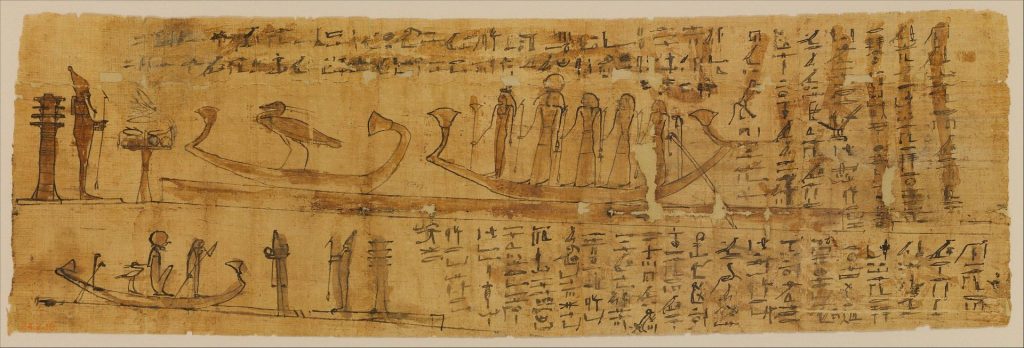
The name sounds dark, almost theatrical, as if it belonged to curses, forbidden chambers, or secret resurrection rites. In reality, the texts behind this modern title were not a single sinister book. They were collections of funerary spells—practical, sacred instructions intended to help the deceased survive the journey after death.
These spells could protect the body, preserve the name, guide the soul through gates, defend it against hostile beings, provide breath and food, and help the deceased stand justified before Osiris. Some spells addressed dangers. Some gave knowledge. Some transformed the deceased into powerful forms. Some helped the heart remain loyal during judgment.
For the wealthy, such texts might be written beautifully on papyrus, personalized with the owner’s name and accompanied by vivid illustrations. Others might have shorter or simpler versions. Spells could also appear on coffins, mummy wrappings, amulets, scarabs, or other funerary objects.
Here again, eternity was layered by access.
The elite could purchase a longer textual architecture for the next world. Others relied on smaller fragments of protection: a spell on an amulet, a formula on a coffin, an image, a name, a family offering, or a simple grave beneath the Egyptian sun.
The Book of the Dead was not a horror object. It was closer to a sacred travel guide for the dead—a manual for crossing a dangerous country where the soul needed passwords, protection, memory, and moral truth.
Seen this way, funerary texts do not pull us away from canopic jars. They help us understand the same religious architecture from another angle. The jars protected the organs. The amulets protected the body. The images provided nourishment. The written spells opened roads, named dangers, and gave the deceased the language needed to pass through the next world.
Together, they reveal a culture that did not leave the dead unprepared.
The Body as a Sacred House
Canopic jars make sense only when we understand the body as a sacred house.
For the ancient Egyptians, the dead body was not useless matter. It was a dwelling place of identity. It had to be prepared so the person could continue beyond death. The mummy was the preserved structure. The heart was the moral witness. The name was the thread of memory. The ka received offerings. The ba moved between worlds. The tomb held the person within a system of ritual return.
In this architecture, the canopic jars were like side chambers of the inner house.
They held what had been removed but not rejected. They protected what was vulnerable. They allowed the body to be divided without being destroyed. They gave each organ a guardian and each guardian a place.
This is why canopic jars remain so compelling in a museum. They are intimate and cosmic at once. They speak of organs, but also of gods. They belong to embalming, but also to theology. They are small enough to stand in a display case, yet large enough in meaning to open an entire vision of the afterlife.
They tell us that the Egyptians did not treat death as emptiness.
They organized it.
They furnished it.
They guarded it.
They built around it a sacred system in which even the hidden organs of the body were given names, chambers, protectors, and a future.
The Architecture of the Afterlife
To stand before canopic jars is to stand before a civilization that refused to imagine the human being as easily erased.
The ancient Egyptians knew the body could decay. They knew breath could stop, skin could dry, memory could fade, and names could be lost. Their funerary rituals were a response to that terror. They built against disappearance.
They built with linen and resin.
With stone and paint.
With amulets and spells.
With jars and chests.
With offerings and names.
With gods who watched over the fragile parts of the dead.
The canopic jar was one of the smallest rooms in this vast architecture. Yet within it rested a profound idea: that no part of the person should be abandoned on the road to eternity.
Not the liver.
Not the lungs.
Not the stomach.
Not the intestines.
Not the heart, which remained to speak.
Not the name, which had to be remembered.
Not the soul, which had to find its way.
Behind museum glass, the jars are silent now. Their owners have vanished into centuries. Their tombs may be broken, their rituals ended, their offerings long gone. And yet the vessels remain, carrying the shape of an ancient hope.
They remind us that for the Egyptians, the afterlife was not an abstract dream.
It was a place to be prepared for.
A passage to be survived.
A house to be built.
And in that house, even the innermost chambers of the body were not left in darkness.