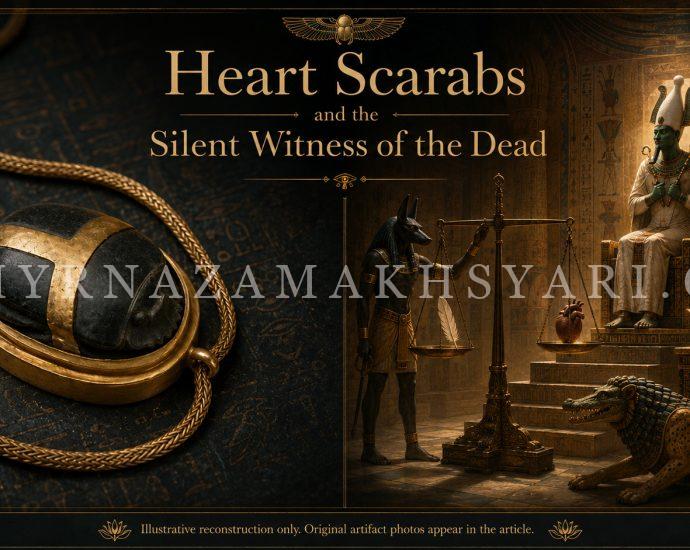
Illustrative reconstruction of an ancient Egyptian heart scarab and the weighing of the heart before Osiris, with Anubis, Thoth, Maat’s feather, and Ammit.

The Heart Scarab of Hatnefer may appear as a small carved beetle suspended from gold, but in ancient Egyptian belief it belonged to one of the most serious moments after death: the weighing of the heart. Unlike the organs protected in canopic jars, the heart usually remained inside the body because it carried memory, thought, and moral truth. Engraved with a spell from the Book of the Dead, the heart scarab asked the heart not to testify against its owner before Osiris. More than an amulet, it was a quiet protection against the fear that the heart itself might become the final witness.Unearth the Story
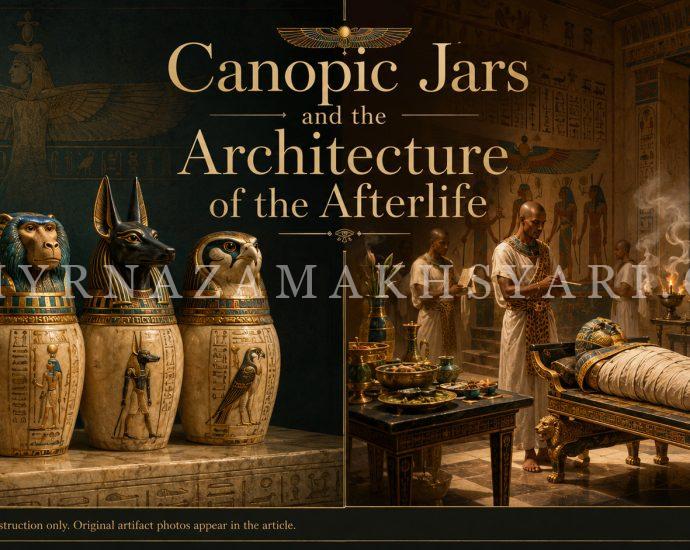
Illustrative reconstruction of ancient Egyptian canopic jars and a funerary ritual scene, showing the Four Sons of Horus and the preparation of the dead for the afterlife.

Behind museum glass, canopic jars may appear as four quiet vessels from ancient Egypt. Yet these jars once guarded the inner body of the dead, protecting the liver, lungs, stomach, and intestines under the care of the Four Sons of Horus. More than funerary containers, they formed part of a sacred architecture of the afterlife—one built from mummification, divine guardianship, ritual texts, memory, and the ancient hope that no part of the person should be abandoned on the road to eternity.Unearth the Story