There are burdens the body learns to carry before the mind knows how to speak of them.
They embody meaning without language. They arrive without memory of origin. They do not announce themselves as grief, nor present themselves as fear. They simply settle—quietly—somewhere between the breath and the ribs, becoming part of how one stands, how one moves, how one remains.
This is not heaviness born of a single moment. It is the kind that gathers slowly. From days that required endurance. From silences that asked too much. From strength practiced so often it forgot it was once a choice.
Often, those who carry such weight do not call it suffering.
In the oldest understanding of the world—long before the language of psychology or inner wounds—there was no name for emotional burden as it is known today. The ancient mind did not divide pain into categories. There was no word for trauma, no term for unseen fracture. Yet this absence did not mean the absence of knowing.
They understood weight as something that arrives from the world itself. From seasons that stretched too long. From deaths that returned too often. From vows inherited rather than chosen. From roles that could not be refused. From the slow shifting of order beneath the sky.
The weight was not believed to rise from a broken soul. It was believed to rest upon a living one. They did not ask why they suffered. They asked instead: what has come to rest upon me?
For something that settles upon a person can arrive without fault. Without sin. Without failure. Sometimes it means only this: that you are still standing in the world.
In their understanding, the inner center—what they sensed as the place of will and breath—could feel pressed not because it was weak, but because life itself was leaning close. The pressure was not shameful. It was a sign of contact.
The elders did not speak of removing such weight. They spoke of learning how to remain beneath it without breaking.
As one remains beneath weather. As one waits through drought. As one stands through flood.
The weight was not an enemy. It was a season. To endure it was not heroism. It was presence.
They call it normal. They continue. And continuation becomes a language of its own.
The ancient world knew this state well. Not as a lesson, nor as a teaching, but as an observation written into life itself. There were seasons when survival did not feel heroic. It felt repetitive. Dawn followed night not as promise, but as procedure.
Yet even then, the breath did not abandon the body. It stayed. And staying—quiet, uncelebrated—was enough.
In times like these, the soul does not ask to be lifted. It asks only not to be questioned. Not every ache wishes to be understood. Some only wish to exist without explanation.
You may notice this weight when stillness arrives. When distraction falls away and the body finally has room to speak in its own manner. It does not speak in sentences. It speaks in posture. In the way the shoulders soften reluctantly. In the hesitation before rest. In the unfamiliar feeling of not having to hold oneself together.
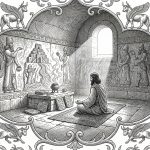
Nothing here will ask you to release what you are not ready to loosen. There is no urgency placed upon lightness. The chamber does not believe that relief must be immediate to be real.
Sometimes, the gentlest shift is not removal, but recognition. To sit with what has no name is not surrender. It is acknowledgment.
The earliest peoples understood that some burdens belonged to the season itself. They were not meant to be solved within a day, nor purified through effort. They were carried as one carries dusk—knowing it would pass, yet not demanding it hurry.
So they rested when they could. They allowed the fire to burn low. They trusted that the body knew when to rise again.
If you feel the weight today, let it be here without defense. You are not required to make sense of it. You are not required to overcome it. You are not required to be grateful for its lessons. You are only asked—gently—to remain.
Even now, the breath continues its quiet work. Not to repair. Not to transform. Only to remind the body that it has not been abandoned by time.
This moment does not ask you to become lighter. It asks only that you be held. And sometimes, being held is the beginning— not of change, but of mercy.
Stay as long as you need. The weight does not frighten this chamber. It has known heavier silences before.
Long ago—before words were trusted to carry meaning—there was an understanding passed without speech: that some weights were never meant to be lifted quickly. They were meant to be borne until the world itself softened its hold. And when they finally left, they did not depart with ceremony. They simply loosened, like dusk giving way to night, leaving no lesson behind—only the quiet knowledge that you endured, and that was enough.