A Contemporary Lustral Chamber for the Modern Home
A bathroom is often understood as one of the most practical rooms in a house. It is a place for cleansing, grooming, and preparing the body for daily life. Yet throughout human history, water has rarely been treated as merely functional. Long before the modern bathroom became a domestic necessity, water carried ritual, symbolic, spiritual, and psychological meaning. It purified, restored, consecrated, and marked transitions between states of being.
This Neo-Babylonian inspired master bathroom begins from that deeper understanding. It does not treat bathing as a routine act alone. It reframes the bathroom as a contemporary lustral chamber—a private architectural setting where water becomes a medium of renewal, where the body is placed within order, and where ancient symbolic memory is translated into modern domestic life.
The room is not an archaeological reconstruction of a Mesopotamian bathroom. That distinction is important. Ancient Mesopotamian houses did not contain bathrooms in the modern sense, nor did they include freestanding tubs, glass shower enclosures, or contemporary plumbing systems. This design is not an attempt to imitate the past literally. Instead, it works through synthesis. It takes selected symbolic, material, and spatial ideas from ancient Mesopotamia—water, lions, cuneiform, date palms, lapis lazuli, gold, axial order, ritual cleansing, and sacred protection—and reinterprets them through a contemporary interior language.
The result is a room that stands between scholarship and sensation. It can be read architecturally, historically, psychologically, and emotionally. For the designer, it offers a case study in thematic coherence. For the architect, it demonstrates the power of axis, symmetry, threshold, proportion, and focal hierarchy. For the historian, it evokes Mesopotamian cosmology without claiming literal reconstruction. For the ordinary reader, it offers something more immediate: the desire to stand there, to hear the water falling from the lion’s mouth, to feel the coolness of pale stone beneath the feet, and to enter a space where cleansing feels almost ceremonial.
This is the strength of design synthesis at its most refined. It does not merely borrow motifs. It translates meaning.
From Function to Ritual
The central idea of this bathroom is simple but profound: cleansing is not only physical.
Modern interiors often separate function from meaning. A bathroom must be efficient, hygienic, waterproof, well-lit, and convenient. Those requirements remain essential. Yet when function alone becomes the entire language of a space, something of human experience is reduced. The body is served, but not always honored. The routine is completed, but not always deepened.
This design restores another layer to the act of bathing. It suggests that daily rituals can become moments of inward restoration when supported by architecture. The room does not ask the user merely to wash. It invites the user to pause.
That pause is created through atmosphere, proportion, material, and symbolic order. The circular tub is not hidden in a corner; it is enthroned at the center. The lion fountain is not treated as decoration; it becomes the room’s symbolic axis. The walls are not blank surfaces; they become archives of script and memory. The palms are not casual greenery; they rise like living columns. The gold fixtures do not simply signal refinement; they carry warmth, precision, and ceremonial brightness.
Every element supports the same narrative: the body enters water, but the mind enters stillness.
In this sense, the bathroom becomes a threshold between the ordinary and the contemplative. It remains fully domestic, yet it borrows the emotional structure of ritual space. It creates a gentle separation from the rest of the home, not through isolation, but through order.
Water and the Mesopotamian Imagination
In ancient Mesopotamian thought, water was never an empty element. It was inseparable from life, fertility, wisdom, purification, and cosmic origin. One of the most important divine figures associated with water was Enki, known in Akkadian as Ea. His domain, the apsū, referred to the primordial subterranean waters beneath the earth—an unseen source associated with creation, intelligence, order, and hidden knowledge.
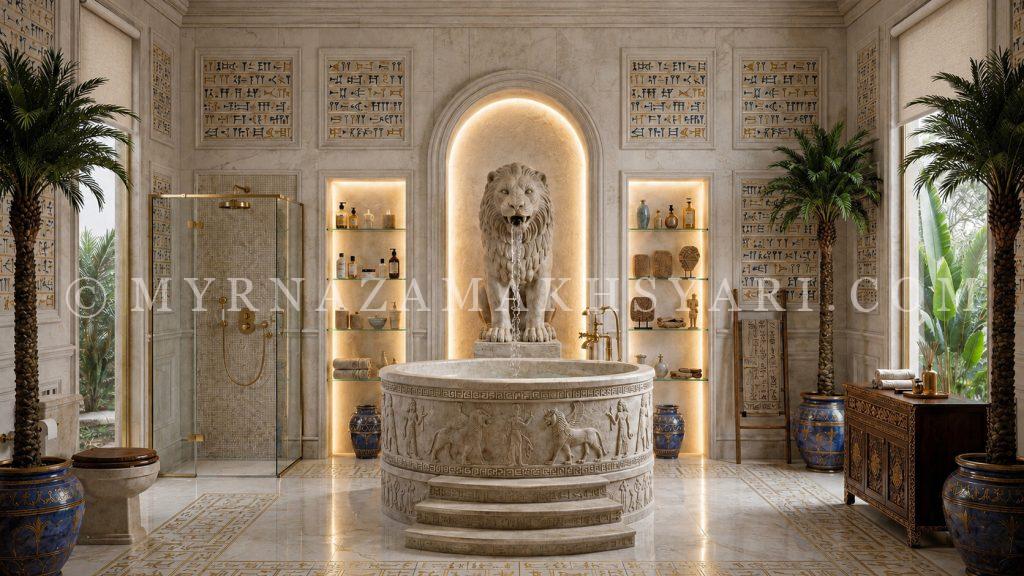
This cosmological background gives the design its conceptual foundation. The water in this bathroom does not simply fill a tub or flow from a fixture. It is staged as a sacred medium. It descends from the mouth of the lion into the circular basin below, creating a visual and acoustic gesture of purification. The movement of water becomes both practical and symbolic.
The sound matters. In interior design, water is often discussed visually, but its auditory presence can be equally transformative. A continuous stream softens silence without breaking it. It masks the harshness of the outer world. It slows perception. It makes the room feel less like a container and more like an inhabited atmosphere.
Here, the falling water suggests return. It recalls the ancient idea that cleansing could remove more than physical dirt: it could prepare the body for prayer, healing, transition, or renewed alignment with order. In a modern setting, this does not need to be read religiously in a strict sense. It can be understood psychologically. Water allows the body to shift from tension to release, from exterior demand to interior quiet.
The bathroom therefore becomes a space of restoration rather than display. The bather is not merely made clean. The bather is gathered back into balance.
The Discipline of Symmetry and Axial Order
At the architectural level, the room is governed by strong bilateral symmetry. This is one of its most important structural decisions.
The circular bathtub occupies the central foreground. Behind it, the Lion of Babylon fountain sits within an illuminated arched niche. On either side, display niches, cuneiform panels, tall windows, blue-and-gold planters, date palms, and functional zones are arranged in a measured rhythm. The eye is drawn naturally toward the center, then allowed to move outward across repeated elements.
This composition produces immediate psychological clarity. The room does not feel accidental. It feels composed.
Symmetry has long carried associations of stability, dignity, permanence, and ceremonial authority. In sacred and monumental architecture, it often communicates a sense of order larger than the individual. In a domestic interior, the same principle can produce calm. The body senses that it is not entering visual chaos. It is entering a place where everything has been placed with intention.
This matters because bathrooms are intimate rooms. The body is vulnerable there. It undresses, washes, rests, and withdraws from public identity. A space with strong order can create a feeling of protection. The user is not exposed to randomness. The room holds the body within a legible structure.
The central axis also gives the bathing experience a processional quality. One does not merely step into a tub. One approaches the focal point of the room. The floor borders, wall panels, palms, light, and fountain all guide attention toward the basin. This subtle sense of approach transforms bathing into arrival.
The room’s order is not cold. It is ceremonial. Like a quiet piece of music built on repetition and balance, it allows the mind to settle into rhythm.
The Arch as Threshold and Frame
Behind the lion fountain, the arched niche acts as one of the room’s most powerful architectural gestures. It frames the lion, gathers light, and creates a threshold within the wall.
The arch has several functions at once. Visually, it softens the strict geometry of the room. Symbolically, it marks the fountain as something set apart. Spatially, it establishes depth and hierarchy. Without the arch, the lion might read as a sculpture placed against a wall. Within the arch, it becomes an icon, a guardian, and a ritual presence.
The warm backlighting intensifies this effect. Light does not simply illuminate the niche; it gives the stone figure an aura. The lion appears to emerge from a field of golden stillness, as though memory itself were glowing behind it.
This is where the Neo-Classical frame and the Neo-Babylonian language meet. The room relies on classical discipline—axis, proportion, balance, clean molding, pale stone, and architectural hierarchy—but its symbolic content comes from Mesopotamian imagination. The arch mediates between these worlds. It gives ancient iconography a contemporary architectural dignity.
Most importantly, the arch creates a psychological boundary. It suggests that the fountain belongs to the inner core of the room. It is not merely an object; it is the source from which the room’s meaning flows.
The Lion of Babylon as Guardian of the Bath
The Lion of Babylon is the symbolic heart of the design.
In Mesopotamian visual culture, the lion carried deep associations with power, sovereignty, protection, and divine force. It was famously linked to Ishtar, a goddess whose domains included love, war, fertility, and kingship. On the walls and processional imagery of Babylon, lions were not only decorative animals; they were charged figures, signs of authority and guardianship.
In this bathroom, the lion is reinterpreted with restraint. It does not roar across the room. It does not overwhelm the bather. It sits in pale stone, frontal and still, releasing water into the tub below. Its power is present, but disciplined.
This distinction is essential. The lion here is not a spectacle. It is a guardian.
Its apotropaic quality—the idea of a protective figure warding off harm or disorder—fits the logic of a lustral chamber. Cleansing, in many ancient traditions, was not only about washing the body. It was also about crossing from impurity to purity, from disorder to order, from vulnerability to restored condition. A guardian figure at the center of such a space reinforces the idea that the bather is entering a protected field.
The water flowing from the lion’s mouth transforms the animal’s symbolism. Power becomes life-giving. Authority becomes restoration. The lion does not consume; it offers. It does not threaten; it consecrates.
This is one of the most elegant gestures in the design: the ancient emblem of royal force becomes the source of cleansing water.
The Circular Basin and the Geometry of Protection
The bathtub’s circular form is not merely aesthetic. It is central to the room’s emotional and symbolic structure.
Most contemporary bathtubs are linear. They have a head end and a foot end, a direction, a front, and a back. A circular tub changes that experience completely. It removes hierarchy. It creates enclosure without aggression. It surrounds the body equally on all sides.
In symbolic terms, the circle often suggests continuity, wholeness, return, and protection. Within the context of water, it can evoke cyclical renewal. The body enters the basin not as though moving from point A to point B, but as though returning to a center.
This is especially powerful in a room otherwise governed by strong vertical and axial lines. The tall windows, wall panels, palms, niches, and central arch all create upward and forward movement. The circular tub interrupts that direction with inwardness. It says: here, the movement stops. Here, the body rests.
The carved reliefs around the basin deepen the sense of enclosure. Winged guardians, ancient figures, and ceremonial imagery form a symbolic perimeter. The tub becomes more than a fixture. It becomes a narrative vessel, a carved ring of memory around the water.
For the bather, this produces a subtle psychological effect. The body is not left exposed in an open field. It is held within form. The carvings do not dominate the person inside the bath; they surround, protect, and witness.
The experience is both intimate and monumental. The bather becomes small within history, yet centered within the room.
Cuneiform Walls as Architectural Memory
The walls are among the most intellectually rich elements of the design. They do not function merely as decorative surfaces. They act as a vertical archive.
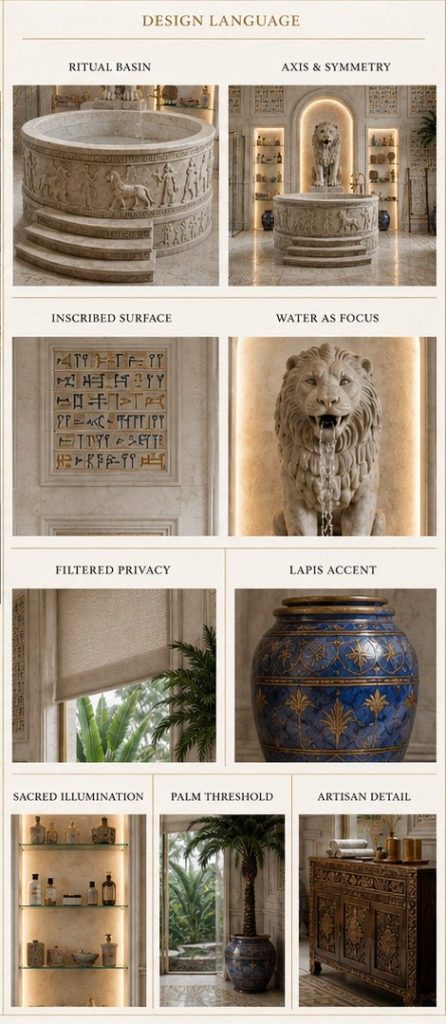
Framed cuneiform panels appear across the room in carefully ordered arrangements. Their blue and gold markings stand against pale architectural surfaces, creating a visual dialogue between inscription and stone. The effect is not that of wallpaper or pattern alone. The panels read as tablets, records, fragments of civilization preserved within the envelope of the room.
Cuneiform was one of humanity’s earliest writing systems. It recorded law, trade, prayer, administration, myth, property, astronomy, and royal power. By bringing its visual language into a domestic interior, the design suggests that the home can hold memory as well as comfort.
This is one of the most important ideas in the room: dwelling is not only shelter. It can also be an act of remembrance.
The cuneiform panels do not need to be read literally by the viewer. Their power lies in their presence as signs of recorded thought. They remind the room that civilization began, in part, with the human desire to mark, preserve, and transmit meaning. In a bathroom dedicated to water and renewal, this creates a fascinating tension: water flows and disappears, while writing endures.
The room is therefore held between two ancient forces: the fluid and the inscribed, the dissolving and the permanent, cleansing and memory.
This balance prevents the design from becoming merely sensual. It gives the space intellectual gravity.
Lapis Lazuli, Gold, and the Celestial Palette
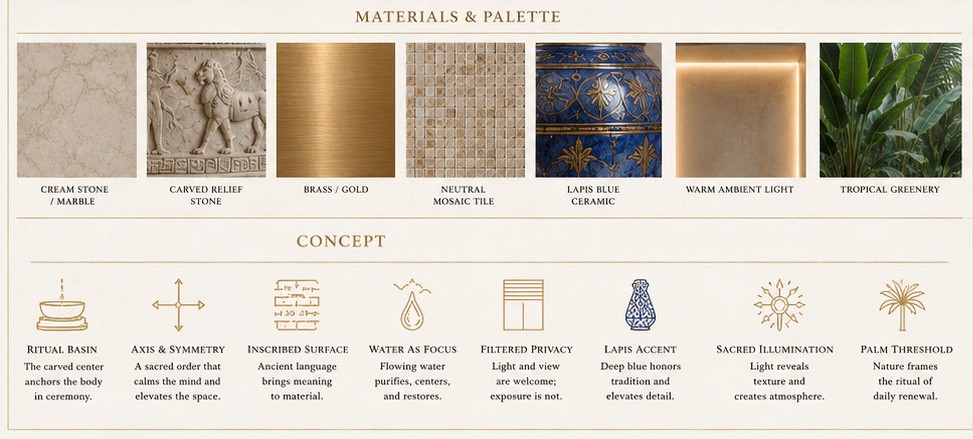
The color palette is rooted in pale stone, deep blue, gold, and green. Each color contributes to the room’s symbolic and emotional composition.
The pale stone establishes calm. It gives the room luminosity and restraint. Without it, the ancient motifs could become visually heavy. The white and cream surfaces act almost like silence in music: they allow the more symbolic elements to resonate without becoming overwhelming.
Against this calm foundation, gold introduces warmth and precision. It appears in fixtures, shower framing, decorative borders, and furniture details. The gold does not feel excessive because it is disciplined. It works as a thread rather than a flood. It catches light, defines edges, and recalls the ceremonial language of ancient palaces and temples.
The deep blue vessels and panels evoke lapis lazuli, one of the most treasured materials of the ancient Near East. Its saturated blue has long been associated with the heavens, divinity, depth, and rarity. In this room, blue performs several roles at once. It anchors the palette, gives contrast to the pale stone, and introduces a celestial quality.
The pairing of blue and gold is especially significant. It suggests night and sun, heaven and flame, depth and radiance. It also gently recalls the color language associated with Babylonian monumental art without reducing the room to imitation.
The result is a palette that feels historical yet fresh. It is not theatrical. It is luminous, measured, and ceremonial.
Date Palms and the Living Architecture of Renewal
The date palms are not secondary accessories. They are essential to the room’s symbolic balance.
In Mesopotamian culture, the date palm was associated with fertility, abundance, cultivated life, and survival. In an arid environment, the palm represented the intimate relationship between water and sustenance. Where palms grew, life could gather. Shade, fruit, and continuity followed.
Placed symmetrically in cobalt-and-gold vessels, the palms in this bathroom act almost like living columns. They echo the verticality of the architecture while softening its stone discipline. Their trunks add texture; their fronds bring movement; their green color introduces breath.
The palms also prevent the room from becoming museum-like. Without them, the bathroom might feel too fixed, too mineral, too still. With them, the space becomes alive. The leaves catch light. Their silhouettes soften the tall windows. Their presence suggests that water is not an abstract symbol, but a life-giving force.
This is biophilic design with historical resonance. The plants are not included only because greenery makes interiors pleasant. They complete the conceptual cycle of the room: water cleanses the body, sustains the palm, and restores the sense of life within architecture.
In this chamber, nature does not oppose civilization. It completes it.
The Absence of Mirrors and the Rejection of the Performative Self
One of the most striking and original decisions in the design is the absence of a dominant mirror.
In contemporary bathrooms, the mirror often controls the room. It turns the body into an image. It asks the user to inspect, judge, correct, and prepare the self for the gaze of the outside world. The bathroom becomes a backstage area for public appearance.
This Neo-Babylonian bathroom chooses another path. It does not center reflection. It centers experience.
By removing the mirror as the primary visual authority, the room changes the psychological meaning of bathing. The body is no longer treated as an object to be evaluated. It becomes a participant in ritual. Attention shifts from appearance to sensation: water, stone, light, scent, sound, temperature, and breath.
This absence is quiet but radical. It allows the room to resist the modern culture of constant self-observation. The bather is not asked, “How do I look?” but rather, “How do I feel? What can be released? What can be restored?”
Within the logic of lustration, this makes sense. Purification is not primarily an act of visual improvement. It is a transformation of condition. One enters with fatigue, dust, heat, heaviness, or restlessness. One leaves altered—not because the mirror confirms it, but because the body knows it.
The absence of mirrors also increases the room’s contemplative quality. Nothing reflects the viewer back too quickly. Nothing interrupts the inward turn. The space allows privacy not only from others, but from the performative self.
That may be one of its deepest forms of refinement.
The Shower as Modern Transparency
Although the room is dense with ancient symbolism, it remains fully contemporary in function. This balance is crucial. A successful design synthesis cannot abandon usability. It must allow symbolic meaning and daily life to coexist.
The glass-enclosed shower is a strong example of this balance. Its transparent structure introduces visual lightness into a room otherwise rich with stone, carving, script, and ornament. The glass prevents the left side of the composition from becoming too heavy. It allows light to move through the space and keeps the architectural rhythm open.
Inside the shower, mosaic tiles create a subtle link with ancient craft traditions. Their small scale catches and refracts light, adding texture without competing with the central tub. The brushed gold fixtures echo the room’s ceremonial palette while remaining unmistakably modern.
The shower’s clarity also reinforces the philosophical structure of the room. If the tub represents immersion, enclosure, and ritual stillness, the shower represents flow, vertical cleansing, and daily function. One is ceremonial; the other is practical. Together, they allow the bathroom to serve both the symbolic and the ordinary needs of the body.
This duality keeps the design alive. It is not a stage set. It can be used.
The Vanity, Display Niches, and Domestic Continuity
On the right side of the room, the dark wood vanity with gold detailing introduces warmth, storage, and domestic familiarity. Its presence is important because it grounds the room in the reality of daily living.
Without such functional elements, the bathroom could become too ceremonial, almost too removed from domestic life. The vanity reminds us that this is still a home. Towels must be stored. Oils, soaps, and personal objects must have a place. Practical needs remain.
Yet the vanity does not break the design language. Its carved or inlaid gold detailing echoes the room’s ancient palette. Its darker wood creates contrast with the pale stone, adding depth and human warmth. It also introduces a crafted quality that feels consistent with the room’s historical references.
The illuminated display niches serve a similar purpose. They hold vessels, bottles, tablets, small sculptures, and objects that hover between utility and artifact. This is a subtle but effective strategy. Storage becomes curation. Everyday items are elevated through placement, light, and proportion.
In many contemporary interiors, shelves become cluttered or purely decorative. Here, the niches are disciplined. Their lighting is warm, their shelves transparent, and their contents carefully arranged. They extend the idea of the bathroom as a chamber of ritual objects, where even practical items participate in the room’s atmosphere.
The domestic and the ceremonial are not separated. They are woven together.
Pale Stone and the Ethics of Restraint
The room contains many symbolic references, yet it does not feel chaotic. This is largely because of the restraint of its architectural shell.
Pale stone walls, clean moldings, and controlled surfaces create a calm foundation. The white and cream tones act as a visual counterweight to the richness of cuneiform panels, blue vessels, gold fixtures, palms, carvings, and the lion fountain. They prevent the room from becoming excessive.
This restraint is one of the most important lessons of the design. Historical inspiration can easily become over-decoration. When too many symbols compete without hierarchy, the result can feel theatrical or confused. Here, the architecture disciplines the ornament.
The room understands hierarchy. The lion is the focal point. The tub is the ritual basin. The cuneiform panels are the archive. The palms are living columns. The shower and vanity provide modern function. The pale stone holds everything together.
This is why the room feels legible. It does not merely contain many beautiful things. It organizes them into meaning.
For designers and architects, this is a valuable principle: complexity requires restraint. A richly themed interior must have quiet surfaces, clear axes, and disciplined proportions, or its symbolism will collapse into visual noise.
In this bathroom, silence is not emptiness. It is structure.
Design Synthesis Rather Than Historical Imitation
The success of this interior lies in the difference between imitation and synthesis.
Imitation copies visible forms. It borrows motifs and places them on surfaces. It often produces rooms that look themed but feel shallow. Synthesis works differently. It asks what a historical culture understood about space, material, ritual, body, nature, and meaning—then translates those ideas into a new context.
This bathroom is not trying to be an ancient Mesopotamian room. It is a contemporary room informed by Mesopotamian symbolic logic. The difference is subtle but essential.
The Lion of Babylon becomes a fountain guardian. Cuneiform becomes architectural memory. The circular tub becomes a lustral basin. Date palms become living columns. Lapis blue and gold become a celestial material palette. Symmetry becomes psychological protection. The absence of mirrors becomes a meditation on the body beyond appearance.
These are not random decorations. They are connected decisions.
That is what gives the room its coherence. Every element participates in the same conceptual world, yet every element is adapted to contemporary life. The room has plumbing, lighting, glass, storage, fixtures, and comfort. It belongs to the present. But its emotional depth comes from the past.
This is the kind of design synthesis that can speak across audiences. An academic reader can analyze its historical references. A designer can study its spatial composition. A lifestyle reader can respond to its atmosphere. A homeowner can imagine the feeling of entering it at the end of a long day.
Good design does not force these readings apart. It allows them to coexist.
The Emotional Experience of the Room
Beyond theory, history, and symbolism, the room succeeds because it makes the viewer want to be there.
One can imagine entering barefoot onto the pale stone floor. The room is bright but not harsh. The gold edges catch the light like warm metal under morning sun. The blue vessels hold the gaze with quiet depth. The palms rise on either side, their leaves softening the room’s ceremonial stillness. Water falls steadily from the lion’s mouth into the circular basin. The sound is gentle, continuous, almost ancient.
There is no mirror demanding attention. No visual noise scattering the mind. No excessive ornament competing for dominance. Instead, the room creates a rare emotional condition: grandeur without pressure.
It feels protective.
The bather stands at the center of an ordered world. Behind the water, the lion watches. Around the room, cuneiform panels hold the memory of writing. The palms breathe silently. The stone receives light. The basin waits.
This is why the design feels more profound than a themed bathroom. It does not merely decorate the act of bathing. It changes its emotional meaning. It turns bathing into a return to the self.
The space gives dignity to solitude.
Conclusion: Where Water Becomes Order
This Neo-Babylonian bathroom demonstrates how contemporary interior design can engage ancient history without becoming nostalgic, theatrical, or academically cold. It shows that historical inspiration is most powerful when it is not copied, but interpreted.
The room is built from contrasts: stone and water, history and modernity, symmetry and softness, inscription and flow, protection and intimacy, ceremony and domestic function. These contrasts do not conflict. They complete one another.
At its center, the Lion of Babylon releases water into a circular basin. Around it, cuneiform panels transform the walls into memory. Lapis blue and gold recall the celestial language of the ancient world. Date palms bring life into the stone chamber. Pale surfaces preserve clarity. Modern fixtures make the room livable. The absence of mirrors redirects the body away from performance and toward presence.
The bathroom becomes a place where cleansing is no longer reduced to hygiene. It becomes continuity. It becomes restoration. It becomes a quiet architectural ritual.
In a world where many interiors are designed to be photographed quickly and consumed at a glance, this room asks for slower attention. It rewards the reader who looks longer. It invites not only admiration, but interpretation.
And perhaps that is its deepest beauty.
It reminds us that a room can do more than serve the body. It can gather memory, shape emotion, discipline light, honor water, and restore the human being—quietly, patiently, beneath the gaze of an ancient lion.