A Living Room Where History Becomes Habitable
A living room is often understood as the social heart of a home. It is where guests are received, conversations unfold, books are opened, tea is served, and the rhythms of domestic life become visible. Yet in this Neo-Classical Babylonian fusion interior, the living room is given a deeper role. It becomes not only a place of comfort, but a chamber of memory—a room where writing, artifact, light, craft, and conversation are gathered into an inhabitable archive.
This is not a literal reconstruction of an ancient Babylonian interior. It does not attempt to reproduce the rooms of Mesopotamia with archaeological precision, nor does it pretend that Neo-Classical moldings, French doors, or upholstered sofas belonged to ancient Babylon. Instead, the room works through design synthesis. It takes selected principles, symbols, materials, and emotional associations from the ancient Mesopotamian world and translates them into a contemporary domestic setting.
The result is a living room that feels at once scholarly and intimate, ceremonial and livable, historical and immediate. It is not a museum, although it contains the language of display. It is not a stage set, although it carries theatrical presence. It is not a shrine, although it treats writing and memory with quiet reverence. It is a salon: a room for thought, hospitality, and cultivated presence.
At its center are not water and purification, as in a lustral chamber, but writing and remembrance. The dominant symbols are not only those of power or divinity, but of civilization itself: cuneiform-inspired inscriptions, clay tablet replicas, books, carved reliefs, lions, date palms, lapis-blue panels, and a richly patterned rug that grounds the entire seating arrangement like a woven map of cultural memory.
The room asks the viewer to slow down. It invites the body to sit, the hand to touch carved wood, the eye to move across wedge-like marks, the mind to remember that civilization was built not only from walls and gates, but from records, laws, stories, trade, ritual, and the human need to preserve meaning.
From Living Room to Archival Salon
The most successful quality of this interior is its shift from simple domestic comfort into what may be called an archival salon. A salon is not merely a formal sitting room. Historically, it suggests conversation, thought, taste, and cultural exchange. An archive, meanwhile, suggests preservation, continuity, evidence, and memory. In this design, the two ideas meet.
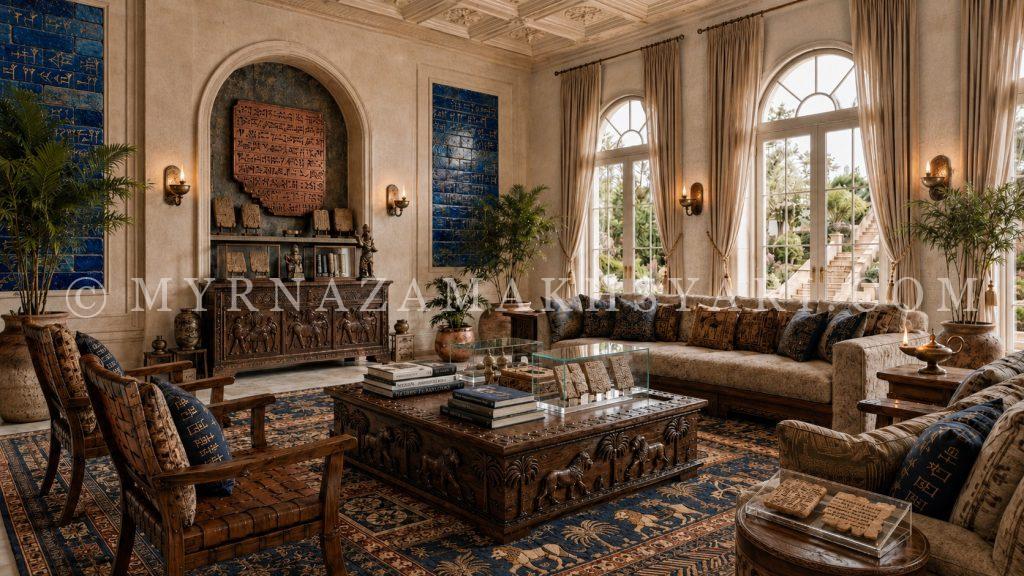
The room remains unmistakably habitable. There are sofas, cushions, armchairs, lamps, a central coffee table, side tables, curtains, rugs, books, and plants. Nothing prevents the space from being used for ordinary life. Yet every practical element carries symbolic weight. The coffee table is also a carved narrative object. The rug is also a symbolic ground. The alcove is also a knowledge niche. The cushions are also carriers of written motif. The plants are also living signs of abundance. The blue panels are also references to sacred and royal color.
This is where the interior becomes more than a themed room. In weaker historical interiors, ancient motifs are often applied like costume: a pattern here, a statue there, a decorative border somewhere else. In this room, the historical references are not scattered ornaments. They are organized into a coherent spatial argument.
The living room becomes a place where history is no longer distant. It is not locked behind glass alone. It enters the texture of living: the pillow, the table, the rug, the cabinet, the light, the view, and the rhythm of conversation.
In that sense, the design proposes a powerful idea: memory does not have to remain monumental in order to be meaningful. It can become domestic. It can sit beside a lamp. It can rest under a hand. It can become part of the way a room is inhabited.
Mesopotamian Cities and the Architecture of Recorded Memory
To understand the deeper logic of this room, one must begin not with style, but with civilization.
Ancient Mesopotamia was one of the great cradles of urban life. Cities such as Uruk, Ur, Babylon, Nippur, and Nineveh were not merely clusters of buildings. They were complex systems of administration, religion, trade, labor, agriculture, law, ritual, and memory. Their existence depended not only on walls, canals, temples, and palaces, but on records.
Writing was one of Mesopotamia’s most profound gifts to human history. Cuneiform began as a system of marks pressed into clay and developed into one of the earliest writing traditions in the world. Through it, people recorded transactions, laws, hymns, omens, myths, letters, astronomical observations, and royal inscriptions. Clay tablets made thought durable. They allowed memory to survive beyond the voice, beyond the body, and often beyond the city itself.
This living room draws from that civilizational foundation. Its cuneiform-inspired panels and tablet displays do not function merely as exotic ornament. They evoke the idea of recorded life: memory made visible, knowledge given form, language pressed into matter.
That is why the room feels intellectually grounded. It does not only borrow from the appearance of Babylon. It borrows from the deeper Mesopotamian relationship between city, writing, authority, and continuity.
A living room is normally a place of speech. People gather there to talk, listen, tell stories, and exchange ideas. By surrounding that social act with references to writing, law, and tablets, the design creates a subtle relationship between oral conversation and recorded memory. The spoken and the inscribed coexist. The room becomes a reminder that civilization depends on both: the warmth of human exchange and the discipline of preservation.
The Neo-Classical Frame: Order as a Vessel for Memory
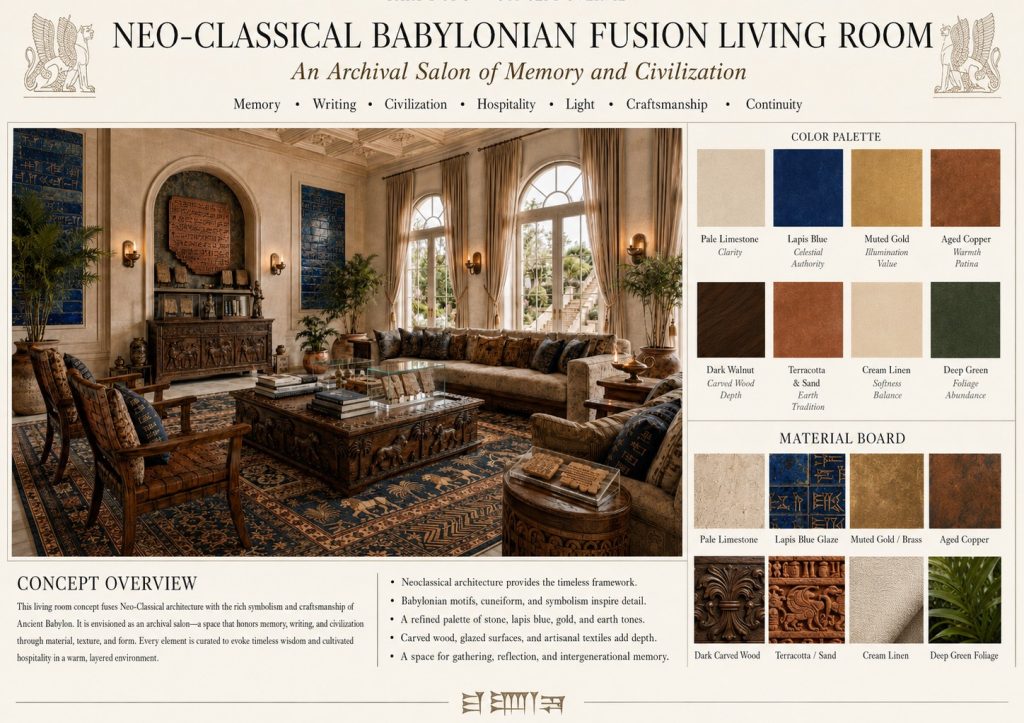
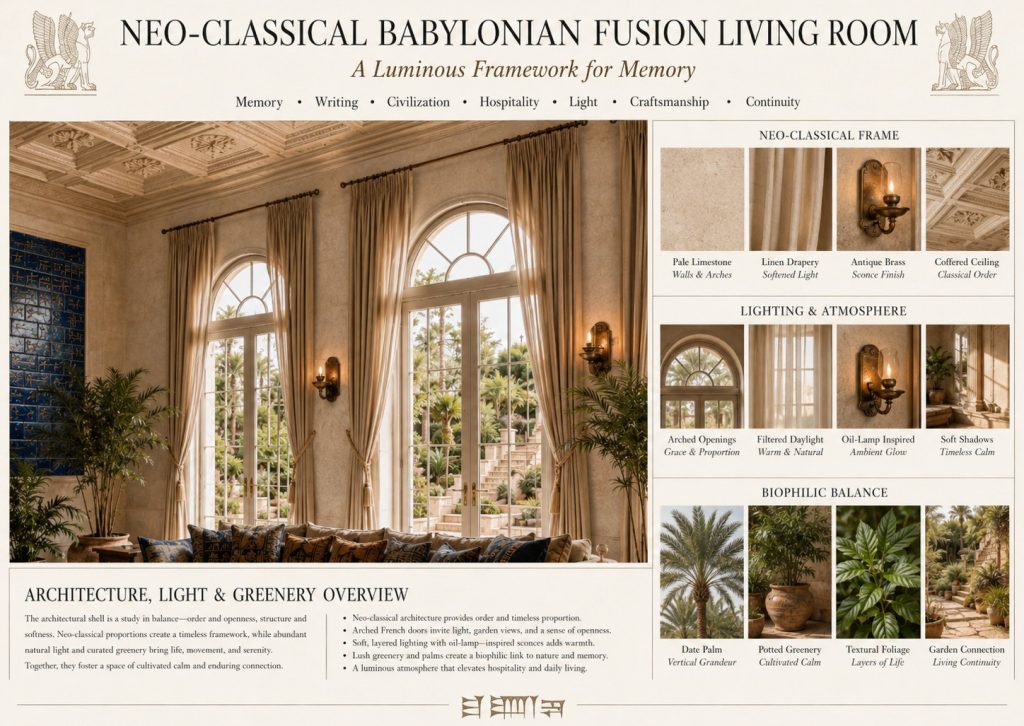
The architectural shell of the room is Neo-Classical in spirit: pale stone surfaces, tall arched windows, formal moldings, a coffered ceiling, proportioned wall panels, and a sense of measured grandeur. These elements are not Mesopotamian in a literal historical sense. Yet they serve an essential role in the design synthesis.
They provide order.
Without this disciplined architectural frame, the room’s many references—cuneiform, carved wood, artifacts, blue glazed panels, patterned textiles, palms, lions, and display cases—could easily become visually overwhelming. The Neo-Classical structure holds them together. It creates hierarchy, rhythm, and calm.
The pale stone walls act as a luminous field. They receive light gently and allow the richer elements to stand forward without chaos. The coffered ceiling gives the room architectural dignity, while the tall windows introduce height, air, and ceremony. The long curtains soften the verticality of the architecture, making the space feel more domestic and less institutional.
This balance is crucial. The room is dense with meaning, but it does not feel crowded in concept. Its symbolism is framed by architectural restraint. Its historical references are organized by proportion. Its visual richness is disciplined by pale surfaces and clear spatial hierarchy.
This is one of the central lessons of the interior: when a design carries deep historical or symbolic content, restraint is not a limitation. It is the condition that allows meaning to remain legible.
The Archive Niche as a Threshold of Literacy
The recessed arch on the main wall functions as the room’s symbolic anchor. In the earlier logic of sacred architecture, an arch often marks threshold, transition, or framed significance. Here, the arch does not lead into another room. It leads inward into memory.
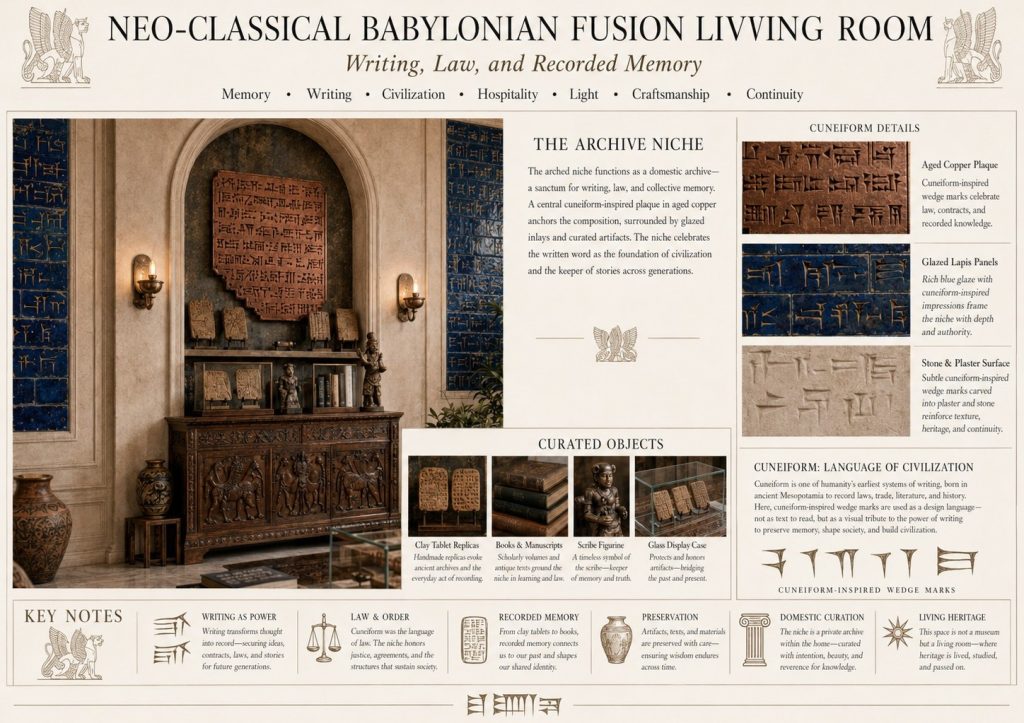
Within the niche, a weathered copper-toned cuneiform plaque occupies the central position. Its surface suggests age, inscription, and the endurance of recorded thought. Below it, smaller tablets, books, objects, and artifact-like pieces are arranged with curatorial discipline. Together, they transform the alcove into an archive niche rather than an altar.
This distinction matters. The room is not asking the viewer to worship the past. It is asking the viewer to read it, contemplate it, and live in conversation with it.
The alcove functions like a domestic cabinet of civilization. It gathers the signs of writing, law, record, and artifact into one architectural focus. The copper plaque provides symbolic gravity, while the smaller tablets and books bring scale and intimacy. The result is reverent without becoming devotional, scholarly without becoming cold.
The darkened interior of the niche also gives depth to the room. Against the pale stone architecture, the alcove appears as a quiet recess of time. It suggests that memory is not always bright and immediate. Sometimes it is held in shadow, waiting for attention.
This is where the living room’s identity becomes clear. The bathroom may center water and purification; this room centers writing and civilization. Its sacredness, if one may use the word carefully, is not ritual purity but recorded memory.
Cuneiform as Inhabited Language
One of the most compelling aspects of this interior is the way cuneiform-inspired writing appears across different scales and surfaces. It is not confined to a single framed object. It appears on blue wall panels, the central plaque, small clay tablet replicas, glass display cases, textile patterns, cushions, and subtle decorative bands.
This creates the sense that writing has entered the room not as display alone, but as atmosphere.
The inscriptions should be understood as cuneiform-inspired rather than literal, fully readable Akkadian texts. Their visual language evokes Babylonian and Akkadian cuneiform through wedge-like marks arranged in disciplined rows and compact groupings. This distinction preserves historical integrity while allowing the design to work symbolically.
The presence of writing on textiles is especially interesting. In a museum, tablets are kept separate from the body, protected from touch. In this living room, the language of inscription is softened into fabric. It appears on cushions and upholstery, entering the realm of comfort. Writing is no longer only something to be preserved behind glass. It becomes something that shares space with the body.
This is a profound design gesture. It suggests that memory is not only archival; it can be inhabited. The written mark moves from the tablet to the wall, from the wall to the textile, from the textile to daily life.
In this way, the room dissolves the boundary between artifact and interior. It allows the history of writing to become part of domestic experience.
Lapis Lazuli Blue and Muted Gold: Color as Orientation
The deep blue panels throughout the room form one of its most powerful visual signatures. Their color evokes lapis lazuli, a stone prized in the ancient Near East and often associated with rarity, heaven, divinity, and royal prestige. In this interior, the blue is used not as a flood of color, but as a series of measured visual anchors.
These lapis-toned surfaces perform several roles. They create contrast against the pale stone walls. They frame the cuneiform-inspired inscriptions. They establish continuity across the room. Most importantly, they guide the eye.
In a symbolically rich interior, the eye needs orientation. It must know where to rest, where to pause, and what to read as important. The blue panels provide that rhythm. They punctuate the pale architecture like fragments of glazed memory.
The muted gold markings add warmth and ceremonial brightness. Gold, in this context, does not function as mere luxury. It functions as illumination. It catches the light, clarifies the inscription, and recalls the relationship between authority, craft, and sacred value in ancient material culture.
The palette is therefore not decorative in the shallow sense. Pale stone, deep blue, aged copper, dark carved wood, warm brass, terracotta, cream textiles, and green plants all participate in a larger emotional structure. The room feels luminous, but not empty; rich, but not heavy; formal, but not distant.
The Carved Coffee Table as Social Center
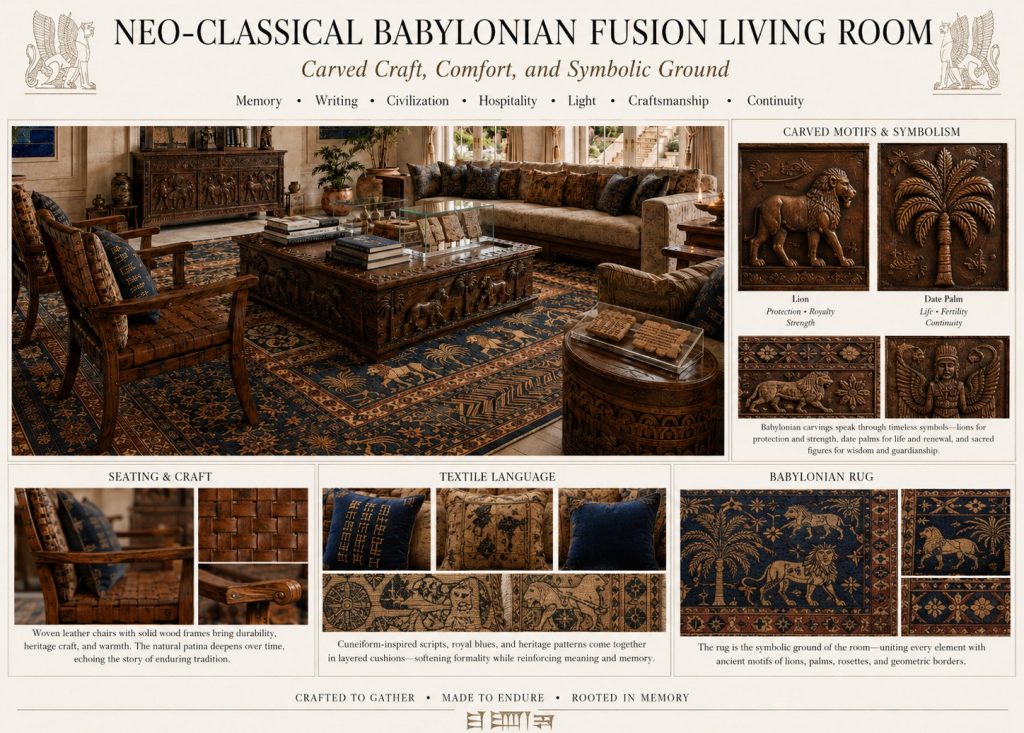
At the center of the seating arrangement stands a large carved wooden coffee table. It is one of the most important objects in the room because it grounds the entire composition.
Unlike the vertical blue panels or the elevated archive niche, the coffee table belongs to the horizontal life of the room. It is where books are placed, objects are gathered, glasses may be set down, and conversation naturally orbits. Its carved sides feature motifs such as lions, date palms, animal processions, and ornamental borders. These references connect the table to ancient Mesopotamian visual language while allowing it to remain functional.
The lion motif suggests protection, royal authority, and strength. The date palm suggests fertility, life, continuity, and cultivated abundance. Together, they transform the table into more than a piece of furniture. It becomes a symbolic platform for social life.
The presence of books and a low glass display case on the table deepens its meaning. This is not a coffee table styled with anonymous decorative objects. It is a curated surface. Books on Mesopotamia, tablet replicas, and small artifacts turn the table into a place of encounter between scholarship and hospitality.
This is a subtle but important shift. The room does not place knowledge only on the wall, above the viewer. It brings knowledge to the center of human gathering. The archive comes down to the level of conversation.
The Glass Display Cases: Curating Memory in Domestic Space
The glass display cases are among the most contemporary elements in the room, yet they serve the ancient concept beautifully. They introduce the language of museum curation into a domestic interior without making the room feel cold.
One display case rests on the central coffee table. Another appears on a side table, holding clay tablet-like fragments. Their transparency protects the objects while allowing them to remain visually present. This creates a layered relationship between distance and intimacy. The artifacts are close enough to belong to the room, but set apart enough to be respected.
This curatorial gesture is highly effective because it clarifies the room’s identity as an archival salon. The objects are not scattered casually. They are framed, protected, and given meaning by placement. Their presence suggests that the homeowner is not merely decorating with history, but living in deliberate relationship with it.
In a contemporary home, display can easily become vanity. Here, it becomes interpretation. The glass cases tell the viewer that objects matter not because they are expensive, but because they carry memory.
They also balance the room’s heavier materials. Glass introduces lightness among carved wood, stone, ceramic, leather, and woven textiles. It allows the ancient references to breathe within a modern visual language.
The Babylonian Rug as Symbolic Ground
The rug is one of the strongest revisions in the room because it transforms the floor into a symbolic field. Rather than using a generic floral pattern, the design turns to a Babylonian-inspired vocabulary: stylized lions, date palms, rosettes, geometric borders, and cuneiform-like banding.
This decision is important because the living room is a room of gathering. People sit around a shared center. Furniture needs a ground, both visually and emotionally. The rug provides that ground.
Its deep blue, terracotta, sand, cream, and muted gold tones connect the room’s other elements: the lapis panels, carved wood, brass accents, pale stone, and textile cushions. It anchors the palette and prevents the seating area from floating.
Symbolically, the rug becomes a woven map of the room’s themes. Lions speak of protection and authority. Date palms speak of life and continuity. Geometric borders speak of order. The deep blue recalls celestial depth. The warm earth tones recall clay, brick, and ancient ground.
The rug also softens the formality of the room. Without it, the interior might feel too stony, too museum-like, too architectural. With it, the space becomes warmer, more tactile, and more welcoming. It invites feet, bodies, conversation, and stillness.
It turns history into texture.
Textile, Leather, and the Human Scale
The room’s grandeur is balanced by materials that invite touch. The woven leather chairs, upholstered sofas, patterned cushions, layered textiles, and rug all soften the architectural and archival elements.
This is essential because a room with too much stone, paneling, and artifact display can become austere. It may impress, but it may not welcome. Here, the seating restores human scale.
The leather strap chairs are especially effective. Their woven construction introduces craft, tactility, and a slightly rustic counterpoint to the polished grandeur of the architecture. They feel handmade, grounded, and bodily. They also suggest the human hand as an important part of civilization—not only the hand that writes, but the hand that weaves, carves, binds, and builds.
The sofas and cushions expand the room’s social function. Their script-inspired motifs connect them to the larger theme of writing, yet their softness keeps them domestic. The blue pillows with gold wedge-like marks echo the wall panels, allowing the cuneiform language to move from architecture to touchable comfort.
This is where the room becomes truly livable. It is not only to be admired from a distance. It offers places to sit, lean, read, rest, and speak.
Date Palms, Plants, and the Living Memory of the Garden
Plants play a crucial role in preventing the room from becoming too mineral or archival. Tall palms and leafy greenery appear in large vessels, some in cobalt-blue ceramic planters, others in warmer earthenware tones. Through them, the room breathes.
In the ancient Mesopotamian imagination, the date palm was closely associated with life, fertility, nourishment, and cultivated abundance. In an arid environment, the palm was never merely decorative. It signified water, care, continuity, and settlement. Where palms flourished, human life could endure.
In this living room, the plants perform both symbolic and atmospheric work. They soften stone walls, carved wood, and formal panels. They add movement, irregularity, and living shadow. They also connect the interior to the garden beyond the tall French doors.
The exterior view matters. Through the arched windows and doors, the eye moves toward steps, greenery, and daylight. This prevents the room from turning entirely inward. The archive opens toward life. Memory opens toward the garden.
The plants and view remind us that civilization is not only made of tablets and laws. It is also made of cultivation: water managed, gardens tended, palms sustained, shade created, food grown, and domestic life protected.
Light, Sconces, and the Warmth of Antiquity
Light in this room is layered with care. Natural daylight enters through tall arched openings, giving the pale stone surfaces a soft glow. The curtains filter the brightness, preventing glare and allowing the room to feel warm rather than stark. The interior lights—especially the oil-lamp-inspired wall sconces and table lamps—add a second register of atmosphere.
These sconces are important because they evoke antiquity without requiring literal historical reconstruction. They may be read as modern electric fixtures inspired by ancient oil lamps, combining contemporary safety with historical memory. Their warm glow animates the stone walls and gives the room an evening-like intimacy even in daylight.
Light also clarifies hierarchy. It touches the archive niche, glances across carved wood, reflects faintly on glass cases, and deepens the blue of the glazed panels. It allows the room’s symbolic elements to emerge slowly rather than shouting for attention.
This restraint is part of the room’s sophistication. It does not rely on spectacle. It relies on accumulation: a glow on copper, a shadow under carved relief, a shimmer on ceramic blue, a soft fold in the curtain, a highlight on glass.
In this room, light behaves like memory. It does not reveal everything at once. It asks the viewer to look again.
Modern Comfort and Domestic Function
Despite its historical density, the room remains fully functional. This is one of the clearest signs that the synthesis has succeeded.
The seating arrangement supports conversation. The coffee table provides a central surface. Side tables hold books, lamps, and display objects. The curtains regulate light and privacy. Plants enrich the atmosphere. Display cases protect delicate pieces. The rug defines the seating zone. The archive niche functions as both visual anchor and curated storage.
Nothing in the room exists only as spectacle. Even the symbolic elements are integrated into domestic use. The cushions can be touched. The chairs can be occupied. The books can be opened. The table can gather people. The objects can be studied. The room can host guests, conversation, reading, reflection, and quiet evenings.
This matters because design synthesis must never abandon life. A historically inspired room becomes meaningful only when it can be inhabited without losing its dignity. If it becomes too precious to use, it fails as a living interior. If it becomes too ordinary, it loses its conceptual power.
This living room stands between those extremes. It is refined, but not frozen. It is scholarly, but not sterile. It is richly symbolic, but still human.
Restraint, Hierarchy, and the Avoidance of Excess
A room with this many historical references risks becoming overwhelming. Cuneiform panels, carved reliefs, tablets, artifact displays, patterned rug, symbolic pillows, blue ceramics, palms, brass lighting, and Neo-Classical architecture could easily compete with one another.
What prevents this is hierarchy.
The archive niche is the symbolic anchor. The coffee table is the social center. The blue panels are visual orientation points. The rug is the symbolic ground. The plants provide organic balance. The pale stone walls create breathing space. The furniture mediates between monumentality and comfort.
Because each element has a role, the room remains legible. The eye knows how to move. It rests on the niche, descends to the console, crosses to the coffee table, follows the rug, moves toward the sofa, rises to the windows, and returns to the blue panels.
The design is rich, but not random.
This is one of the most important principles for any historically inspired interior: symbolism requires discipline. Without proportion, restraint, and hierarchy, historical references become noise. With them, they become language.
In this living room, ornament is not simply added. It is composed.
Design Synthesis Rather Than Historical Imitation
The room’s success depends on the difference between imitation and synthesis.
Imitation copies forms without necessarily understanding their meaning. It might reproduce a motif, a color, or an artifact-like object, but the result often feels superficial. Synthesis works more deeply. It asks what the historical source represents and how that meaning can be translated into contemporary life.
This room does not try to become Babylon. It listens to Babylon.
It takes from Mesopotamia the idea of writing as memory, the tablet as record, the lion as protection, the date palm as continuity, the blue-and-gold palette as celestial authority, the carved relief as narrative, and the archive as a foundation of urban life. It then places those ideas within a Neo-Classical domestic room designed for modern comfort.
The result is not archaeological reconstruction. It is interpretive continuity.
This distinction allows the design to remain honest. It acknowledges that the room belongs to the present, while allowing the past to inform its emotional and symbolic depth. It does not collapse history into nostalgia. It transforms history into atmosphere.
That is why the room can speak to different readers. An architect may notice its proportion and spatial hierarchy. A designer may study its material layering and palette. A historian may recognize its engagement with writing and urban memory. A general reader may simply want to sit there, surrounded by warm light, carved wood, books, and the quiet presence of ancient signs.
Good synthesis allows all these readings to coexist.
The Emotional Experience of the Room
Beyond theory, history, and composition, the living room succeeds because it creates longing.
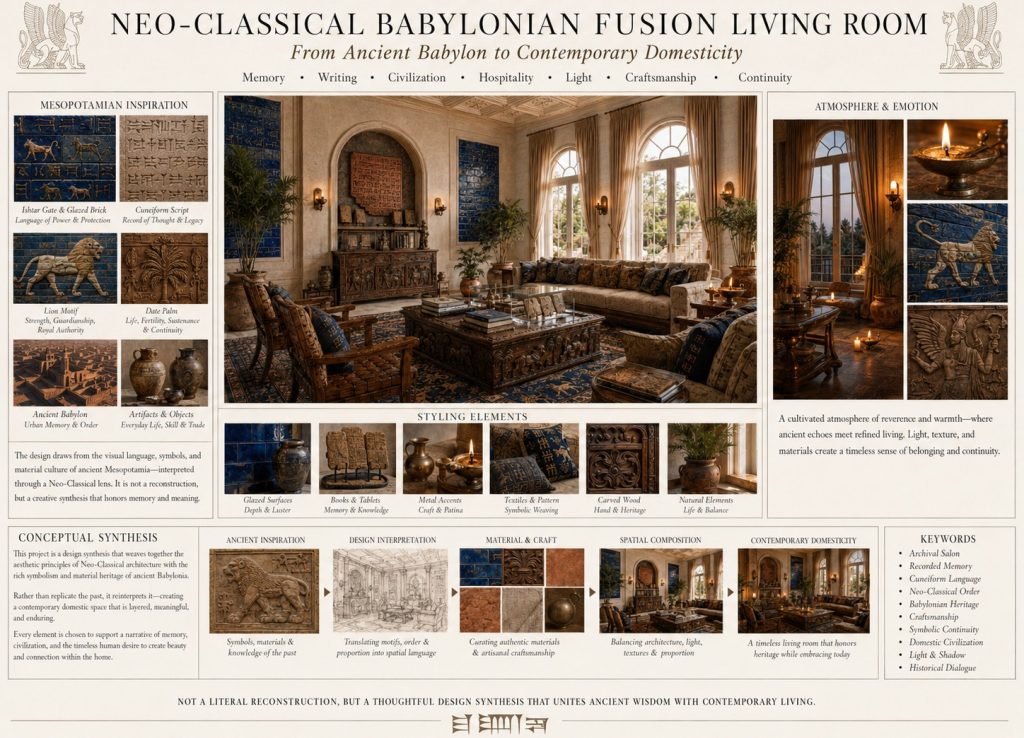
One can imagine entering the room in late afternoon, when the garden light has softened and the sconces have begun to glow. The pale stone walls hold warmth. The curtains fall in quiet folds. The blue glazed panels deepen in color. The carved wooden table sits at the center like a low monument to hospitality. Books wait in small stacks. Clay tablets rest behind glass. Cushions gather along the sofa. The rug stretches beneath everything like a woven field of lions, palms, and ancient order.
There is grandeur here, but it does not intimidate. There is scholarship, but it does not exclude. There is history, but it does not feel dead.
The room offers a rare atmosphere: cultivated calm.
It is easy to imagine guests sitting in the leather chairs, a conversation unfolding slowly, someone reaching for a book, someone else looking toward the archive niche, the garden beyond the windows breathing softly in the background. The room does not demand quick admiration. It rewards slow attention.
This is the difference between a decorated room and a meaningful interior. A decorated room impresses the eye. A meaningful interior continues to speak after the first glance.
This living room speaks in layers: stone, blue, copper, wood, textile, script, glass, leaf, light.
Conclusion: A Living Carrier of Memory
The Neo-Classical Babylonian fusion living room demonstrates how ancient memory can be translated into contemporary domestic design without becoming theatrical, literal, or academically cold. It shows that the past can be inhabited when it is approached with discipline, restraint, and emotional intelligence.
The room is built from carefully balanced contrasts: pale stone and dark wood, archive and comfort, inscription and conversation, monumentality and touch, history and daily life. Its blue panels recall the authority of sacred color. Its cuneiform-inspired inscriptions evoke the birth of recorded memory. Its archive niche gathers tablets, books, and objects into a quiet center of knowledge. Its carved coffee table grounds the social life of the room. Its rug creates a symbolic field beneath the body. Its plants and garden view restore life to the architectural order.
Nothing is accidental. Everything participates in a larger idea.
This is not history displayed at a distance. It is history softened into habitation.
The room reminds us that civilization is not only built in temples, palaces, and city walls. It is also carried into domestic space: in what we choose to preserve, where we choose to sit, what we allow our eyes to rest upon, and how we let memory shape the atmosphere of everyday life.
In this living room, Babylon is not reconstructed. It is remembered.
And through that remembrance, the room becomes something more enduring than a themed interior. It becomes an archival salon of light, language, craft, and conversation—a living carrier of memory, where the ancient world does not remain behind us, but sits quietly beside us, waiting to be read again.