An Earthen Neo-Babylonian Fusion Living Room Case Study
A Room Built from the Memory of Earth
A living room is usually imagined as a place of welcome: a room for guests, conversation, rest, and the quiet rituals of domestic life. Yet this Earthen Neo-Babylonian Fusion Living Room extends that role into something deeper. It becomes a chamber of material memory—a space where earth, writing, craft, symmetry, and archaeology are translated into a contemporary interior that feels both grounded and alive.
Unlike interiors that borrow the ancient world only as surface decoration, this room does not depend on spectacle. Its power comes from weight, texture, and order. The walls do not simply enclose the room; they appear to carry the memory of mudbrick cities. The central niche does not merely display an artifact; it gathers the symbolic authority of writing and recorded time. The carved furniture is not only functional; it recalls relief, craft, and continuity. The palms are not casual greenery; they stand as living signs of abundance in a landscape shaped by water, cultivation, and sun.
This is not an archaeological reconstruction of a Babylonian house. It does not claim that ancient Mesopotamian living rooms looked like this, nor does it attempt to reproduce the domestic interiors of Babylon, Uruk, or Nippur with literal historical precision. The room belongs unmistakably to the present. Its sofas, curtains, lighting, coffee table arrangement, and Neo-Classical architectural envelope are contemporary in use and comfort.
Its deeper language, however, looks backward.
It draws from Mesopotamian material culture: mudbrick, clay tablets, cuneiform-inspired inscriptions, lapis-blue surfaces, muted gold, lions, date palms, carved relief, woven textures, and the symbolic power of ordered space. These references are not scattered randomly. They are gathered into a coherent interior philosophy: a room where archaeology is not something distant, buried, or untouchable, but something that can shape atmosphere, proportion, comfort, and emotional experience.
If the luminous white Babylonian living room speaks of archival clarity and recorded civilization, this earthen room speaks of excavation, permanence, and the memory of matter. It feels closer to soil, clay, sun-baked brick, carved wood, aged metal, and the warmth of objects handled by human hands.
It is not history displayed at a distance. It is history made inhabitable.
From Living Room to Archaeological Salon
The conceptual identity of this room may be described as an archaeological salon. It is a salon because it remains social and domestic: a place for sitting, speaking, reading, receiving, and dwelling. It is archaeological because its atmosphere is shaped by the idea of material evidence—surfaces that appear weathered, objects that evoke excavation, and motifs that suggest fragments of a civilization remembered through touch.
This distinction is important. A museum presents artifacts for observation. A salon invites human exchange. This room stands between the two. It allows artifact-like elements to exist within the warmth of domestic life, without turning the home into a cold exhibition space.
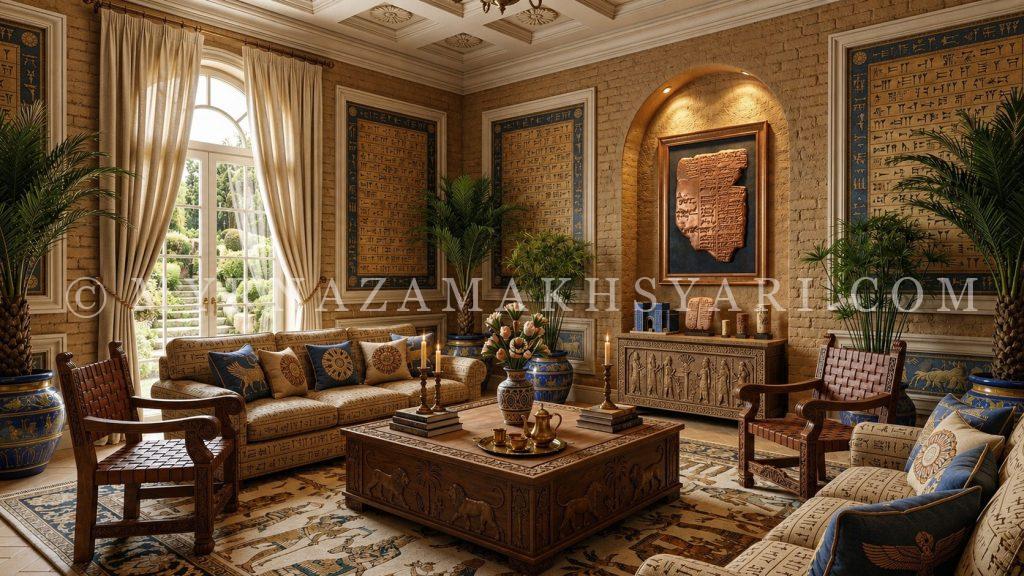
The seating arrangement makes the room hospitable. Sofas, woven leather chairs, cushions, and a central coffee table create a conversational field. Yet the surrounding walls, panels, niche, and carved motifs give that field an archaeological gravity. One does not simply sit in a decorated room. One sits within a layered interpretation of ancient urban memory.
The room’s success lies in this balance. It does not bury comfort beneath history, nor does it reduce history into pattern. The ancient references are strong, but they remain disciplined. The modern function is clear, but it is enriched by symbolic depth.
Every major element participates in this synthesis. The exposed earthen wall recalls mudbrick construction. The central arch frames a cuneiform-inspired plaque as a symbolic object of memory. The wall panels suggest tablets and inscriptions. The carved coffee table and console introduce narrative relief. The rug and cushions soften the space with textile warmth. The palms restore life to the mineral palette. The Neo-Classical ceiling and moldings impose order, hierarchy, and proportion.
This is where the room becomes more than a themed interior. It becomes an argument about how ancient principles can still inform contemporary space: not by imitation, but by translation.
Mudbrick Memory and the Architecture of Earth
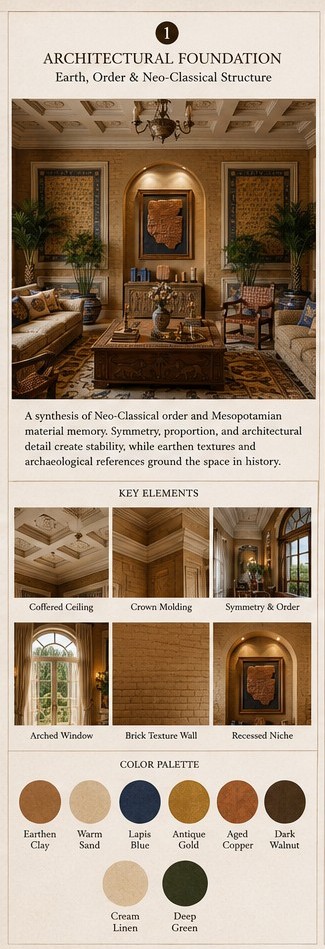
The most defining material gesture in this room is the exposed earthen wall. Its surface immediately changes the emotional temperature of the interior. Unlike polished stone or smooth plaster, the brick texture carries the suggestion of age, labor, climate, and construction. It gives the room a tactile relationship to the ground.
In ancient Mesopotamia, earth was not merely a background material. It was one of the foundations of architecture itself. Mudbrick shaped houses, city walls, temple platforms, administrative buildings, and monumental complexes. Sun-dried brick, baked brick, bitumen, plaster, and later glazed brick all belonged to a long material tradition rooted in the resources of riverine landscapes. In a land where stone was not always abundant, earth became structure.
This room translates that material memory into a refined domestic setting. The wall is not left raw in a primitive sense. It is controlled, warm, and integrated into a Neo-Classical architectural frame. That refinement is essential. It prevents the room from feeling like a ruin or stage set. Instead, the brick becomes an archaeological echo: a reminder of ancient construction adapted for contemporary comfort.
The earthen wall also changes how light behaves. It absorbs warmth rather than reflecting it sharply. It creates small shadows along the irregular surface. It gives depth to the background and makes the room feel inhabited by time. Against it, the blue panels and copper plaque become more vivid, while the cream curtains and pale ceiling introduce softness and relief.
This material contrast is one of the room’s strongest qualities. The earth wall grounds the space; the Neo-Classical ceiling elevates it. One belongs to the memory of clay and labor. The other belongs to order and formal refinement. Together, they create a room that feels both ancient and composed.
Neo-Classical Order as a Stabilizing Frame
Although the room’s emotional identity is Mesopotamian and archaeological, its architectural discipline is Neo-Classical. Crown moldings, coffered ceiling panels, formal wall framing, symmetry, and a clear central axis provide the structure that holds the design together.
This frame is not historically Babylonian, and it does not need to be. The purpose of fusion is not to collapse different periods into false authenticity. The purpose is to let one language support another. In this room, Neo-Classical architecture provides proportion, rhythm, and visual discipline. Mesopotamian references provide symbolic depth, material memory, and cultural resonance.
Without the Neo-Classical order, the room might risk becoming too heavy or too archaeological. The wall panels, cuneiform-inspired inscriptions, carved furniture, palms, patterned textiles, and artifact-like objects could compete for attention. But the classical frame gives them hierarchy. It organizes the richness.
The ceiling is especially important. Its coffered structure introduces a sense of permanence and measured grandeur. It draws the eye upward and prevents the room from feeling too compressed by the earthen walls. The moldings create crisp lines that counterbalance the rougher brick texture. The result is a dialogue between refinement and earth, between formal order and archaeological warmth.
This balance also affects the psychology of the room. Symmetry and proportion create calm. They make the space feel intelligible. The body senses order before the mind names it. In a room filled with historical references, this order is not merely aesthetic. It is what allows complexity to become peaceful.
Symmetry, Stability, and the Domestic Translation of Power
The room is carefully organized around balance. Paired wall panels, repeated palms, facing chairs, a central coffee table, and a prominent niche all contribute to a strong compositional rhythm. This symmetry gives the space a feeling of authority, but not severity.
In ancient imperial and ceremonial architecture, order was often used to communicate power. Processional routes, gateways, framed entrances, repeated reliefs, and axial arrangements guided the body and disciplined perception. A person entering such a space would understand, even physically, that architecture could express hierarchy and control.
This living room translates that principle into a domestic scale. The symmetry does not intimidate. It reassures. It creates a sense of protection and predictability. The room feels gathered, not scattered. The eye moves easily from one side to the other, from the seating to the niche, from the blue panels to the palms, from the carved table to the sofa.
The effect is psychological as much as visual. Balanced space can calm the body. It reduces visual anxiety. It allows a richly decorated room to feel composed rather than crowded. Here, symmetry becomes a form of hospitality. It gives the guest a sense of arrival, orientation, and welcome.
This is one of the most successful aspects of the design. It takes an ancient spatial value—order as a sign of permanence—and transforms it into a contemporary emotional experience: order as comfort.
The Recessed Niche as Archaeological Threshold
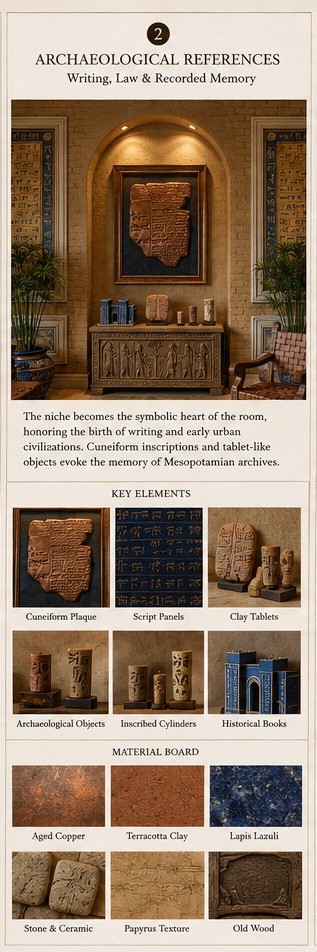
The central recessed arch is the symbolic heart of the room. It frames the copper-toned cuneiform plaque and gives the entire composition a focal center. More than a decorative feature, the niche functions as an archaeological threshold.
It evokes the logic of ancient gateways, framed entrances, and ceremonial approaches without claiming to reproduce any single Mesopotamian architectural form literally. In Mesopotamian cities, thresholds mattered. Gates, courts, temple approaches, and processional paths shaped how bodies moved toward meaning. They controlled sequence, attention, and anticipation.
In this room, the niche creates a similar effect on a smaller scale. It draws the eye inward. It separates the plaque from the surrounding wall. It marks the object inside as significant. The warm lighting within the recess deepens this sense of focus, making the plaque appear as though it has been unearthed and honored.
The arch also mediates between architecture and artifact. Without it, the plaque might feel like a framed wall decoration. Within it, the plaque becomes an object of presence. It is not merely placed on the wall; it is housed.
The niche therefore transforms the living room into a place of encounter. The viewer is invited to approach, look, pause, and read—not necessarily to read the signs literally, but to recognize the cultural power of inscription itself.
Cuneiform, Law, and Recorded Memory
The copper-toned plaque within the niche represents the room’s most direct reference to writing. Its cuneiform-inspired marks evoke one of humanity’s earliest systems of recorded language: signs impressed into clay, organized into lines, and preserved across centuries.
Cuneiform was not only writing in a literary sense. It was administrative, legal, economic, ritual, astronomical, scholarly, and political. Through clay tablets, Mesopotamian societies recorded contracts, lists, royal inscriptions, hymns, omens, myths, laws, and correspondence. Writing allowed cities to extend memory beyond individual lives. It made transaction, authority, and tradition durable.
This is why the plaque is so important in the room. It suggests that the foundations of urban civilization were not only architectural, but textual. Cities were built from walls and canals, but they were also built from records.
The room’s use of cuneiform-inspired panels and textile motifs extends this idea throughout the space. Writing is not confined to the central plaque. It appears in wall panels, upholstery, cushion patterns, and decorative bands. This diffusion turns inscription into atmosphere.
For historical accuracy, these visual inscriptions should be understood as cuneiform-inspired rather than fully readable Akkadian or Babylonian texts. Their value in the design lies in their wedge-like form, horizontal rhythm, and symbolic association with recorded memory. They evoke the presence of writing without pretending that every mark is a verified ancient sentence.
This distinction is subtle but important. It keeps the design intellectually honest. The room does not fake archaeology. It interprets it.
Lapis Blue, Muted Gold, and the Memory of Glazed Splendor
Against the earthen walls, the lapis-blue panels become powerful visual anchors. Their deep blue immediately recalls the glazed brick traditions associated with Babylonian monumental art, most famously the blue surfaces and animal processions of the Ishtar Gate. Paired with muted gold and ochre tones, the panels introduce a celestial and royal language into an otherwise grounded palette.
This contrast is essential to the room’s emotional depth. Earth alone could become too heavy. Blue alone could become too decorative or precious. Together, they balance gravity and elevation.
The blue panels suggest protection, divinity, prestige, and memory. Their framed arrangement gives them the feeling of tablets, inscriptions, or architectural fragments. They do not cover every wall. They appear at measured intervals, allowing them to function as orientation points rather than visual noise.
Muted gold adds warmth and hierarchy. It appears in inscriptions, borders, fixtures, and accessories. The gold is not loud. It behaves more like aged light: a softened metallic presence that catches the eye without overpowering the room.
The palette therefore speaks in layers: mudbrick earth, lapis blue, aged copper, muted gold, carved walnut, cream linen, green foliage, and terracotta warmth. It is a palette of excavation and refinement. It suggests both the ground and the heavens, the buried and the ceremonial.
The Lion and the Date Palm: Protection and Continuity
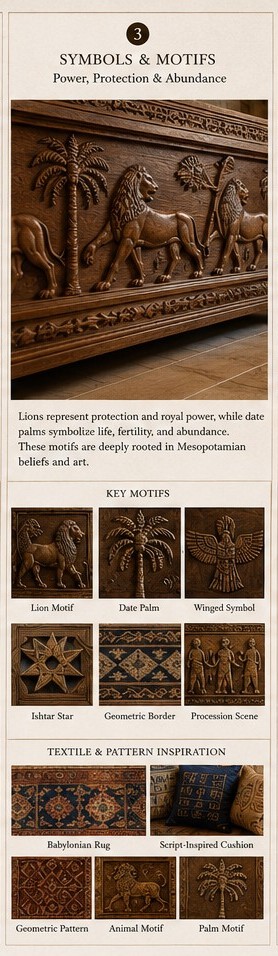
Two motifs appear repeatedly in the room: the lion and the date palm. Both are deeply appropriate to a Mesopotamian-inspired interior.
The lion carries associations of power, protection, kingship, and divine force. In Babylonian visual culture, lions were famously connected with Ishtar and appeared in monumental decorative programs. Their presence in this living room, especially on the carved coffee table and decorative panels, gives the space a protective symbolic charge. The lion does not make the room aggressive. It gives it guardianship.
The date palm carries a different but equally important meaning. It evokes fertility, nourishment, cultivated abundance, and survival. In Mesopotamia’s riverine and arid landscapes, the palm was tied to the relationship between water, agriculture, shade, and settlement. It represented continuity: the ongoing life of a place.
Together, the lion and palm create a balanced symbolic vocabulary. One speaks of strength; the other of life. One guards; the other sustains. One belongs to authority; the other to fertility and domestic abundance.
Their presence on furniture and textile surfaces allows the symbolism to enter everyday use. The motifs are not isolated as museum imagery. They become part of the objects around which people sit, speak, rest, and gather.
This is a key feature of successful design synthesis: symbols must not float above life. They must find a place within it.
The Coffee Table as Grounded Monument
The central coffee table is the room’s strongest horizontal anchor. Large, carved, and richly detailed, it gives weight to the seating arrangement and acts as the domestic counterpart to the niche.
If the niche is the room’s vertical symbol of recorded memory, the coffee table is its social ground. It is where the room gathers itself around human presence. Guests sit around it. Books, cups, candles, and small objects rest upon it. Conversation crosses over it.
Its carved reliefs give it a monumental quality, yet its function keeps it intimate. This dual role is powerful. The table is not a museum plinth, but it carries the memory of relief sculpture. It is not an altar, but it becomes the center of social ritual. It is not ancient, but it speaks through ancient motifs.
The use of dark carved wood is especially effective against the earthen walls and pale upholstery. It deepens the palette and gives the room tactile richness. Its surface suggests craft, weight, and endurance. Unlike smooth modern minimalism, this table invites the eye to linger.
In a contemporary interior, such a piece could easily become too heavy if unsupported by the rest of the room. Here, however, the rug, chairs, wall panels, and niche all share its symbolic vocabulary. The table does not dominate alone. It belongs to the room’s larger order.
Textiles, Rugs, and the Softening of Archaeology
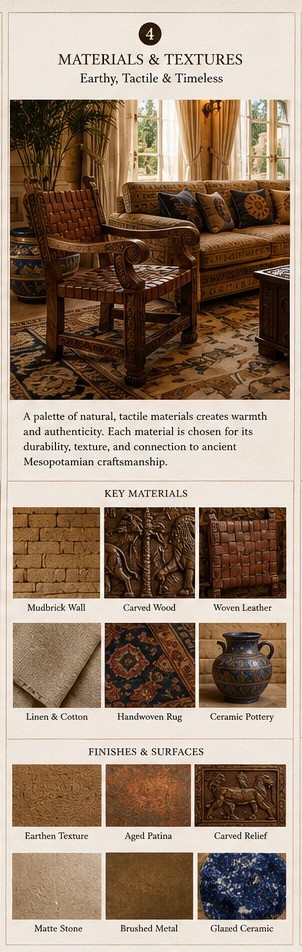
The room’s textiles play an essential role in making the archaeological concept livable. Without the sofa fabric, cushions, curtains, leather seating, and rug, the interior could become too hard, too symbolic, or too museum-like.
The rug is especially important. It defines the seating area and creates a symbolic ground beneath the furniture. Its patterns echo ancient motifs while remaining soft enough for domestic use. It transforms the floor into a field of memory, not as a literal archaeological map, but as an atmospheric layer of pattern, order, and warmth.
The cushions and upholstery continue this soft translation of history. Script-inspired motifs appear on fabric surfaces, allowing the language of cuneiform to leave the tablet and enter daily comfort. This is one of the room’s more subtle gestures: writing becomes touchable. Memory becomes textile. History becomes something one can lean against.
The woven leather chairs introduce another form of tactile intelligence. Their material and construction bring human scale into the room. They suggest craft, handwork, and durability. Their presence prevents the room from becoming too polished. They remind us that ancient civilizations were not made only by kings and scribes, but also by makers: weavers, carpenters, potters, brickmakers, metalworkers, and laborers.
This is why the room feels warm. Its archaeology is softened by the body.
Palms, Greenery, and the Living Counterpart to Clay
The living plants are not incidental. They are necessary.
In a room dominated by earth, wood, carved relief, brick texture, and artifact-like panels, greenery provides movement and breath. The palms in blue vessels and the smaller plants around the room soften the architectural geometry and bring vertical life into the composition.
Symbolically, palms are deeply resonant in a Mesopotamian context. The date palm was tied to sustenance, fertility, shade, and cultivated prosperity. It represented a form of life made possible by water and human care. In a land shaped by rivers and irrigation, plant life was never merely decorative. It was civilizational.
In this living room, the palms stand almost like living columns. They echo the vertical panels and tall window, but their leaves interrupt the room’s rigidity. They create shadow, texture, and organic rhythm. They also connect the interior to the garden beyond the window, allowing the room to feel rooted in a larger landscape.
This is an important emotional counterbalance. The earthen walls speak of what has endured. The plants speak of what continues to grow.
Together, they create a room that is not only archaeological, but alive.
Light, Candle Glow, and Material Depth
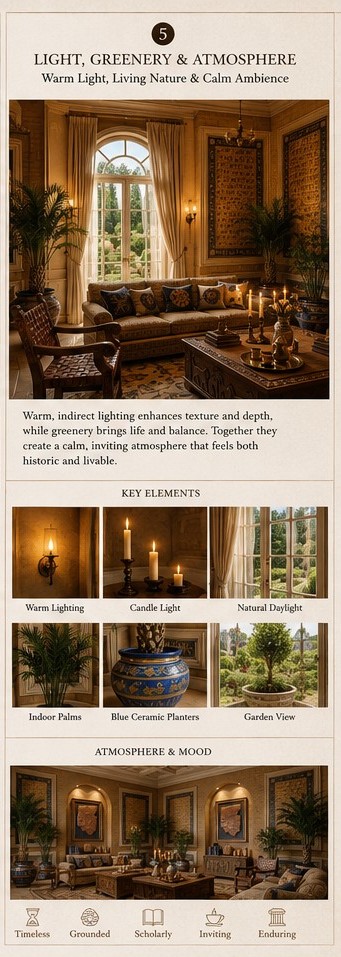
Lighting in this interior is warm, restrained, and highly atmospheric. Natural light enters through the arched window and is softened by cream curtains. This filtered daylight prevents the earthen palette from becoming dark or heavy. It gives the room a breathable quality.
Artificial lighting is equally important. Candles, sconces, and warm lamps create small pools of illumination. They emphasize texture rather than spectacle. Instead of flattening the room with bright overhead light, the lighting allows surfaces to reveal themselves slowly: the irregularity of brick, the shine of blue glaze, the patina of copper, the depth of carved wood, the folds of linen, the roughness of ceramic vessels.
This is exactly the right lighting strategy for an archaeological interior. The aim is not brightness alone, but revelation. Texture needs shadow. Relief needs grazing light. Patina needs warmth. A room like this should not be overlit, because its beauty depends on depth.
The candle-like glow also strengthens the emotional atmosphere. It suggests slowness, age, and intimacy. The room feels less like a showroom and more like a place where evening could gather naturally.
Light becomes a medium of time.
Modern Comfort and Functional Continuity
Despite its historical density, the room remains practical. This is crucial. A design synthesis succeeds only when symbolic depth and daily function can coexist.
The seating arrangement is clear and usable. Sofas and chairs support conversation. The coffee table provides a central surface. The curtains control light and privacy. The plants soften the room. The wall panels and niche create visual focus. The rug defines the gathering zone. Candles, lamps, and accessories create atmosphere without disrupting function.
The room is therefore not frozen as a display. It can be lived in.
This is where many historically inspired interiors fail. They become too precious, too theatrical, or too overloaded with objects. A room may impress visually but feel impossible to inhabit. Here, the balance is better. The historical references are strong, but the room still offers comfort, softness, and human scale.
The best evidence of success is that one can imagine using the space. Someone could sit on the sofa with a book. Guests could gather around the table. A quiet conversation could unfold in the evening light. The room could hold silence, hospitality, thought, and rest.
That livability is not separate from the design concept. It completes it. History becomes meaningful in the home only when it can participate in life.
Restraint and Symbolic Hierarchy
The room contains many references: brick texture, cuneiform-inspired panels, copper plaque, carved furniture, lion motifs, date palms, blue vessels, patterned rug, woven chairs, Neo-Classical moldings, warm lighting, and garden views. Without hierarchy, these elements could become overwhelming.
What saves the room is restraint.
The palette is rich but controlled. The strongest colors—blue, gold, copper, and deep wood—are balanced by earth, cream, and linen. The major symbols are repeated, but not randomly. The lion, palm, writing, and tablet motifs appear in different forms, creating continuity without complete uniformity.
The central niche holds symbolic authority. The coffee table grounds the seating. The blue panels anchor the walls. The palms soften the verticals. The rug gathers the furniture. The Neo-Classical frame maintains proportion. Each element has a role.
This is why the room feels composed rather than merely decorated. It understands that historical reference requires discipline. Too much symbolism can become noise. Too little can become superficial. Here, the design finds a middle path: rich enough to be meaningful, restrained enough to remain habitable.
In this sense, the room teaches an important design principle. Fusion is not achieved by adding more. It is achieved by choosing carefully.
Archaeology as Atmosphere, Not Theme
The most refined aspect of this interior is that archaeology is treated as atmosphere rather than theme.
A themed room announces itself too loudly. It often depends on recognizable motifs that can be consumed quickly: a statue, a pattern, a dramatic color, a few symbolic objects. But atmosphere works more slowly. It emerges from the relationship between surfaces, light, texture, proportion, and memory.
This room does not need to shout “Babylon” through every object. Its Babylonian spirit comes from accumulation: the earth wall, the cuneiform plaque, the blue panels, the palm vessels, the carved relief, the lion motifs, the date palms, the warm patina, the sense of order, the archaeological stillness.
The result is deeper than a decorative theme. It feels as though the room has absorbed an ancient logic and translated it into contemporary living.
This is design synthesis at its strongest. It is not about historical costume. It is about allowing ancient ideas—order, durability, inscription, protection, cultivation, craft, and material honesty—to shape the emotional structure of a modern room.
The Emotional Experience of the Room
Beyond its architectural and symbolic logic, the room succeeds because it produces a strong emotional response.
One can imagine entering it in late afternoon. The earth-toned walls hold the warmth of the sun. The cream curtains move slightly near the arched window. The blue panels glow with a depth that feels almost mineral. The copper plaque in the niche catches the light like something recovered from time. The carved coffee table sits low and solid in the center. The palms rise quietly from cobalt vessels. The leather chairs wait with their woven seats. The rug softens the ground beneath the feet.
There is a sense of stillness here, but not emptiness. The room feels inhabited by memory.
It is not grand in a cold way. It is protective. It surrounds the body with texture, proportion, and warm shadow. It invites conversation, but also contemplation. It makes one want to sit, look, and stay.
That emotional quality is what separates a meaningful interior from a decorated one. A decorated room may be visually impressive at first glance. A meaningful room continues to unfold. It gives the viewer reasons to return: the pattern on the rug, the carved lion, the clay-like wall, the plaque in the niche, the leaves against the window, the quiet glow of candlelight.
This room rewards slowness.
Conclusion: Where Earth Remembers
The Earthen Neo-Babylonian Fusion Living Room demonstrates how contemporary interior design can engage ancient history without becoming literal, theatrical, or academically distant. It shows that archaeology can inform atmosphere, not only decoration. It shows that mudbrick memory, cuneiform writing, symbolic motifs, and ancient spatial values can be translated into a room that is warm, functional, and emotionally resonant.
The design is built from careful contrasts: earth and refinement, archaeology and comfort, order and warmth, inscription and textile, monumentality and human scale. Its Neo-Classical frame provides proportion and stability. Its earthen walls evoke ancient material traditions. Its cuneiform-inspired plaque recalls writing, law, and recorded memory. Its lions and date palms speak of protection and continuity. Its blue panels and gold accents suggest celestial authority. Its carved wood, woven leather, rug, and curtains make the past tactile and livable.
This is not a room that imitates Babylon.
It remembers Babylon through material, symbol, and atmosphere.
In that remembrance, the living room becomes something more than a beautiful interior. It becomes an earthen salon of archaeological memory: a place where the ground of ancient cities seems to rise quietly into the present, where history is not only studied or displayed, but felt beneath the hand, beneath the eye, beneath the body at rest.
Here, earth is not silent.
It holds order. It holds memory. It holds the warmth of civilizations that once pressed their words into clay, built their walls from soil, and trusted that what was made by human hands might endure beyond the breath of its makers.