How Ancient Civilizations Turned Liquid into Gesture, Offering, and Order
Before pouring became ordinary, it was sacred.
A hand lifted a vessel. A thin stream of water, milk, oil, wine, or beer crossed the air. It touched stone, earth, altar, basin, grave, or offering table. The liquid did not merely fall. It entered a relationship.
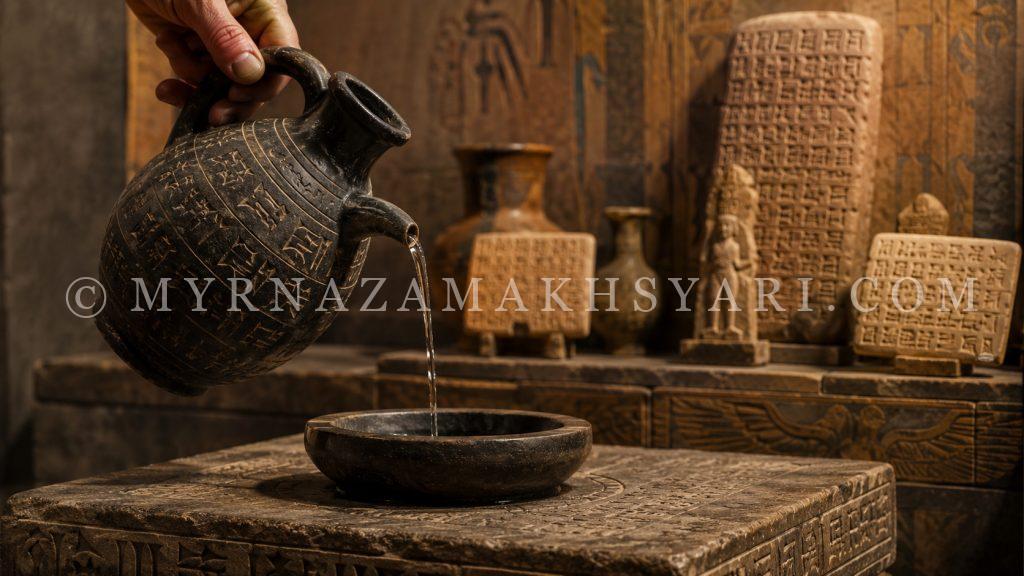
In the ancient world, pouring was not always a practical act. It could be a form of speech. It could honor a god, awaken the dead, purify a space, mark a vow, soothe a spirit, or restore balance between the human and the divine. A libation vessel, therefore, was never only a container. It was a ritual instrument shaped for a moment of release.
To look at such vessels is to look at a quiet theology of movement. The bowl holds. The spout directs. The hand mediates. The liquid travels. Something once contained is offered outward, crossing from possession into devotion.
This is the sacred logic of pouring.
Unlike a statue, a libation does not remain upright before the eye. Unlike bread or fruit, it is not simply placed and left behind. Liquid changes form as it is given. It flows, spreads, sinks, stains, evaporates, or disappears into the ground. Its power lies partly in this vanishing. The offering is visible for only a moment, yet the act leaves meaning behind.
Across Mesopotamia, Egypt, and the wider ancient world, ritual vessels and libation bowls reveal how deeply ancient civilizations understood the relationship between body, matter, and sacred order. A vessel could be carved from stone, shaped from clay, cast in metal, or glazed in luminous color. Yet its importance was not only in its material beauty. Its true life began when it was held, tilted, and emptied.
In that gesture, the human body became part of the ritual architecture.
The hand was not separate from the altar. The liquid was not separate from prayer. The vessel was not separate from the god, the dead, or the invisible order being addressed. Everything belonged to one movement: containment, offering, release.
This article follows that movement. It begins in Mesopotamia, where libation imagery appears in temple, seal, and dedicatory contexts, then moves toward Egypt, where water, milk, and ritual vessels were bound to purification, rebirth, and the nourishment of the dead. It also steps briefly into the shadowed edge of ritual life, where bowls and vessels could be used not only to offer and purify, but also to protect, bind, curse, or contain harm.
Between these worlds, one idea returns again and again: ancient people did not pour because liquid was insignificant. They poured because liquid could move where words could not.
The Vessel as a Threshold
A vessel is one of humanity’s oldest forms of thought.
Long before it became a museum object, a bowl was a small architecture of holding. It gathered what the hand could not hold by itself. It gave shape to water, grain, oil, milk, medicine, pigment, perfume, and blood. It allowed the unstable to become momentarily stable. It gave the moving world a rim.
This is why ritual vessels matter. They are not passive objects. They stand at the border between containment and release. A closed jar preserves. An open bowl receives. A spouted vessel directs. A libation cup prepares the moment when what is held must be given away.
In sacred contexts, that moment of giving was never neutral. The liquid that left the vessel did not simply leave one place for another. It crossed a boundary. It moved from human custody into divine presence, from domestic preparation into public ritual, from the visible hand into the invisible order.
The vessel became a threshold.
Its rim marked the line between inside and outside. Its hollow body held the offering before the offering became action. Its surface carried the memory of touch, inscription, carving, polish, use, and repetition. In some cases, the vessel itself bore the name of a ruler, a god, a patron, or a dedication. In others, it remained plain, almost humble, yet still took part in ceremonies that joined household, temple, tomb, and cosmos.
The act of pouring depended on this tension. If the liquid were already scattered, it could not be offered. If it were never released, it could not complete its purpose. The vessel made the offering possible by holding it back first.
This is the paradox of the libation vessel: it exists to contain what must eventually leave.
Ancient ritual was rarely random. It was ordered through sequence, object, speech, direction, posture, and material. A bowl or goblet entered this order as a tool of transformation. In the hand of a worshiper, priest, ruler, mourner, or healer, it could turn water into purification, beer into offering, milk into renewal, oil into consecration, and wine into a sign of honor.
The vessel did not create holiness by itself. Rather, it gave holiness a form through which it could be enacted.
This is why these objects often feel quiet at first glance. Many are small. Some are plain. Others are carved with gods, serpents, inscriptions, or sacred emblems. Yet even the simplest bowl may carry a serious ritual imagination. To pour is to admit that the sacred is not only approached through monuments and temples, but also through the measured motion of the hand.
A ziggurat may rise. A temple may enclose. An altar may receive. But a vessel moves. It brings ritual down to the scale of the body. It allows the sacred to pass through the wrist, the fingers, the palm, and the breath. It turns theology into movement.
Because liquid cannot be held forever, the vessel also teaches a second truth: some offerings are completed only when they disappear.
Mesopotamia: Pouring Before the Gods
In ancient Mesopotamia, the relationship between human beings and the divine world was not imagined as distant or abstract. It was maintained through care, offering, ritual, speech, food, fragrance, water, beer, oil, and gesture. The gods were approached through temples, statues, altars, songs, prayers, and carefully prepared acts. A ritual was not simply a feeling inside the heart. It was something performed through the body, the voice, the hand, and the object.
Within this world, pouring mattered.
A libation was a ritual act of pouring liquid as an offering. The liquid could vary depending on time, place, and purpose. It might be water, beer, wine, oil, milk, or another sacred substance. What made it ritual was not only the liquid itself, but the way it was given. The act of pouring turned a substance into a message.
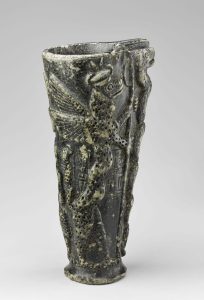
One of the most powerful surviving examples is the libation goblet of Gudea, now preserved in the Louvre. Gudea was the ruler, or prince, of Lagash in southern Mesopotamia during the Neo-Sumerian period. His name is closely connected with temple building, religious dedication, and the careful relationship between rulership and divine service.
The Louvre identifies the object as a libation goblet dedicated by Gudea to the god Ningishzida. It was found at Girsu, also known as Tello, one of the great archaeological sites of ancient Sumer. The goblet is carved from chlorite, a dark stone whose surface could hold both image and inscription. On it appear the figure of Ningishzida and serpent imagery, along with a Sumerian cuneiform dedication.
Even before we interpret the object, those details already tell us something important. This was not an ordinary drinking cup. It carried a god’s name. It carried a ruler’s name. It carried writing. It carried image. It carried material weight. It belonged to a world where a vessel could become a meeting place between devotion, kingship, craftsmanship, and divine presence.
The serpent imagery is especially evocative. In Mesopotamian religious imagination, serpents could be associated with underworld powers, healing, renewal, protection, and divine mystery, depending on the context. In the case of Gudea’s goblet, the serpent belongs to the visual language of Ningishzida, a deity often connected with serpentine forms. The decoration was not separate from the ritual purpose of the object. It framed the act of pouring within a larger sacred vocabulary.
For a modern reader, this may seem strange at first. Why would a vessel for ritual pouring be decorated with divine and serpent imagery? The answer lies in the ancient refusal to separate function from meaning. A ritual vessel could be useful and symbolic at once. It could hold liquid, but it could also hold a relationship.
To pour from such a vessel was not the same as pouring from an anonymous container. The object itself shaped the act. It reminded the person using it, and perhaps the community witnessing it, that the liquid was not being poured into emptiness. It was being offered within a sacred order.
Another Mesopotamian object helps us imagine the gesture more clearly. A Neo-Sumerian cylinder seal in The Metropolitan Museum of Art shows a worshiper pouring a libation from a spouted vessel into another vessel placed on a stepped platform before a seated god. The scene is small, but its meaning is large. We see the worshiper, the vessel, the receiving place, and the divine figure. Everything is arranged around the act.
The spouted vessel is important because it controls the flow. It turns liquid into a line. It gives direction to what would otherwise scatter. The stepped platform also matters because it raises the receiving vessel, separating it from ordinary ground. The seated god receives the action not as a casual observer, but as the center of the scene.
This image helps us understand that libation was not only about substance. It was about arrangement. The worshiper stands before divine presence. The vessel tilts. The liquid descends. The platform receives. A whole theology of order appears in one small gesture.
This is one reason Mesopotamian ritual can feel so architectural, even when the object is small. The temple gave the ritual its great enclosure, but the vessel gave it its intimate movement. The altar or platform marked the sacred place, but the hand completed the action. The god might be represented in seated majesty, but the human body approached through controlled offering.
The act of pouring brought these elements together.
It also reveals something tender about ancient devotion. Human beings could not command the gods, but they could approach them. They could prepare. They could offer. They could repeat inherited gestures. They could place themselves within a ritual order older than their own lives.
A libation, then, was not only a gift. It was a way of saying: we remember the order of things. We know that life depends on forces beyond us. We bring what flows from our world into yours.
The Body, the Hand, and the Ritual Gesture
A vessel does not pour by itself.
However sacred its material, however beautiful its carving, however old its inscription, the vessel still waits for the body. It waits for the hand that lifts it, the wrist that turns it, the eye that measures the direction, and the breath that steadies the gesture.
This is why libation belongs not only to the history of objects, but also to the history of movement.
In a museum, a ritual vessel appears still. It sits behind glass, separated from touch, silence gathering around it. We see its shape, its rim, its surface, its signs of age. We may read its label, learn its date, admire its material, and imagine the civilization that made it. But in its original life, such a vessel was not meant to be still forever. It belonged to an action.
The hand completed the object.
To pour was to bring the body into ritual order. The person who poured did not simply release liquid at random. The movement required attention. The vessel had to be held. The angle had to be controlled. The liquid had to move toward a prepared place. The act was small, but it was not careless.
This is one reason the spouted vessel is so meaningful. A bowl can receive. A cup can hold. But a spout gives direction. It gathers the liquid into a narrow stream and sends it toward a chosen point. In ritual terms, this matters. The liquid does not spill without intention. It travels along a line made by the object and guided by the hand.
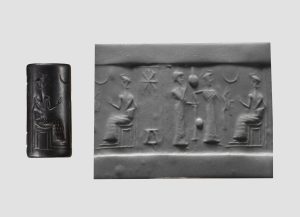
In the Neo-Sumerian cylinder seal preserved in The Metropolitan Museum of Art, this logic becomes visible. A worshiper pours from a spouted vessel before a seated god. The scene is small enough to fit on a seal, yet it contains a complete sacred arrangement. The worshiper is not alone. The god is not distant. The platform is not empty. The vessel is not incidental. The action binds them together.
The seated god receives. The worshiper approaches. The liquid descends. The platform holds the receiving vessel. The spouted container extends the human hand toward the sacred space. Through this movement, the body becomes a bridge.
Ancient rituals often depended on such bridges. They joined what could be seen with what could not be seen. A prayer may vanish into air. Incense may rise and disappear. Water may sink into earth or run across stone. Oil may coat a surface and leave a shine. Milk may mark purity, nourishment, or renewal. Beer or wine may become honor, hospitality, or sacred gift.
The body gives these substances their ritual path.
Without the hand, the liquid remains only liquid. Without the vessel, the hand cannot shape the flow. Without the receiving place, the gesture has no destination. Ritual begins when all these elements agree.
This agreement between body, object, and place is one of the quiet beauties of ancient sacred practice. It shows that meaning was not always built through grand monuments alone. A ziggurat may rise toward heaven. A temple may hold the presence of a god. A statue may stand in divine majesty. But a single hand pouring liquid could also carry the weight of a civilization’s belief.
In this sense, libation vessels reveal an intimate side of ancient religion. They show us that sacred order was not only imagined in the sky, carved into walls, or declared by kings. It was also practiced through repeated bodily acts. Someone had to prepare the liquid. Someone had to carry the vessel. Someone had to stand before the altar, tomb, god, or sacred place. Someone had to pour.
The sacred passed through the ordinary body.
This does not make the ritual less holy. It makes it more profound. Ancient people did not separate spirit from material action as sharply as modern readers sometimes do. The sacred could move through stone, clay, water, oil, breath, voice, hand, and gesture. A ritual object was not merely symbolic because someone looked at it and thought deeply. It became meaningful because it was used within a living sequence.
This is why a vessel’s shape matters. The rounded bowl invites receiving. The narrow neck slows release. The spout directs flow. The rim marks the border between holding and giving. The hollow interior protects the liquid until the appointed moment. Every part of the object participates in the gesture.
A ritual vessel is therefore a kind of choreography made solid. It teaches the hand how to move. It prepares the liquid for its path. It brings the human body into alignment with altar, platform, tomb, floor, threshold, or sacred image. Even when the ritual words are lost to time, the form of the vessel still whispers something about the movement it once required.
Pouring also carries an emotional intelligence. To pour is to give up control. A liquid once released cannot be taken back in the same form. It spreads, sinks, stains, or disappears. The person who pours accepts this loss. The offering becomes complete because it leaves the hand.
The vessel holds for a time, but not forever. The hand lifts, but does not keep. The liquid is prepared, then given. In many ancient rituals, this movement may have expressed honor, purity, nourishment, mourning, devotion, or fear. Yet beneath all those meanings, one pattern remains: the body offers something by letting it go.
Yet the gesture of pouring does more than move liquid from one place to another. It establishes a threshold. The vessel begins in the human hand, close to the body, under control. But the moment the wrist turns and the stream begins, the offering crosses into another domain. It leaves the sphere of possession and enters the sphere of dedication.
This transition helps explain why libation appears so often in funerary, temple, and domestic ritual alike. The act is modest, but its structure is profound: something prepared by human labor is transferred into sacred use. Water drawn from a source, oil pressed from fruit, milk taken from an animal, beer brewed through time and skill—each substance carries traces of the world of work, care, and survival. In libation, those traces are not erased. They are redirected.
The hand therefore does not merely release a liquid. It reclassifies it.
What was once drink, nourishment, or stored resource becomes offering. What belonged to the household, the field, or the body is placed into relation with altar, tomb, deity, or dead. The gesture marks a passage from use to consecration.
Egypt: Milk, Water, and the Reanimation of the Dead
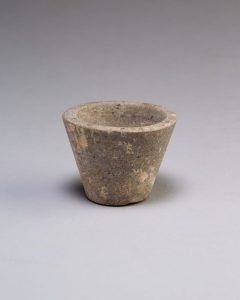
If Mesopotamian libation often brings us before the gods, Egyptian ritual vessels often lead us toward another threshold: the boundary between death and renewed life. In ancient Egypt, pouring was not only a gesture of offering. It could also become part of a ritual language of awakening, cleansing, feeding, and restoring the dead.
This does not mean that every Egyptian vessel had the same purpose, or that every act of pouring carried one fixed meaning. Egyptian ritual life was rich, layered, and deeply ordered. Yet again and again, water, milk, and other ritual substances appear as more than practical materials. They become agents of transition. They help the deceased pass from bodily silence into a transformed state of existence.
One of the clearest examples is connected with the funerary rite known as the Opening of the Mouth. This ceremony was performed so that the deceased, present in the mummified body or in a statue, could regain the powers needed for life in the afterworld. The purpose was not merely symbolic in a vague sense. The ritual restored the ability to breathe, speak, eat, drink, see, and hear. In other words, it returned the faculties through which a person could exist, receive offerings, and participate in life beyond death.
The Metropolitan Museum of Art preserves several vessels from the tomb of Perneb at Saqqara that belonged to this ritual world. Some were made to hold milk, salt water, or fresh water. These substances were not chosen casually. Milk could evoke first nourishment, infancy, renewal, and the beginning of life. Fresh water could cleanse and revive. Salt water could carry associations of purification and ritual washing. Through these liquids, the ceremony reached back toward birth while standing in the presence of death.
This is one of the profound beauties of Egyptian funerary thought. Death was not treated only as an ending. It was also treated as a condition that required preparation, protection, and reanimation. The body had to be preserved. The name had to endure. The tomb had to function. The offerings had to continue. The senses had to be restored so the deceased could receive what was given.
In that world, a vessel could become part of the architecture of rebirth.
The vessel itself did not raise the dead. It belonged to a larger ritual sequence involving words, implements, gestures, offerings, and sacred knowledge. Yet its role was essential because the ritual substances had to be contained, carried, and applied. Without the vessel, the liquid could not be held in readiness. Without the liquid, part of the ceremony’s material language would be absent. Without the gesture, the substance would remain inactive.
Here again we see the same sacred logic that appeared in Mesopotamia, but turned toward a different horizon. In Mesopotamia, the libation may approach the deity through offering. In Egypt, ritual pouring may also approach the dead through restoration. The movement is still simple to the eye, but its meaning is immense. Liquid passes from vessel to ritual space, and in that passage, it helps mark a transformation.
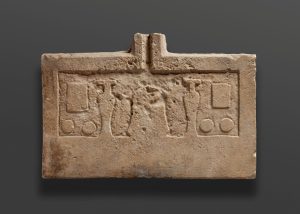
The Egyptian offering table gives another important example. Many offering tables were carved with images of bread, jars, meat, fruit, or other provisions. Some were placed in tomb chapels or temple contexts, where water could be poured over their surfaces. The carved offerings represented nourishment, but the pouring of water helped activate the table as a ritual object. The table was not only seen; it was used. Its surface received the liquid, and through that act, the offering became part of an ongoing relationship between the living and the dead.
This is why offering tables can feel so moving. They are not grand in the same way as pyramids, colossal statues, or temple pylons. Yet they preserve one of the most intimate hopes of ancient Egyptian religion: that the dead would not be abandoned. They would continue to receive care. Their spirits would be nourished. Their names would be remembered. Their existence would not fall into silence.
The act of pouring water over an offering table may seem small, but it carries the weight of continuity. Water touches the carved bread, the inscribed names, the ritual surface, and the imagined presence of the deceased. It joins image and action. It turns representation into service.
In such rituals, liquid does not replace food, prayer, or memory. It moves among them. It refreshes the offering space. It marks attention. It repeats care. It gives physical form to a relationship that death has changed but not erased.
This is especially important when we consider how ancient Egypt understood the afterlife. The dead were not simply gone. They required offerings, protection, remembrance, and ritual maintenance. Tombs were designed not only as burial places, but as active spaces where the living could continue to serve the dead. In this setting, vessels and offering tables formed part of a practical sacred system. They helped keep the bond alive.
Milk, water, and other liquids also remind us that the sacred in Egypt was often connected to the body in very direct ways. To breathe, to drink, to eat, to see, and to hear were not minor details. They were signs of animation. They belonged to personhood. A being who could receive nourishment and perceive the world was not merely an object. He or she had been ritually restored to a meaningful state of existence.
The Opening of the Mouth ceremony makes this logic visible. The deceased required more than preservation. The body or statue needed to be ritually awakened. The mouth had to open so that breath, speech, and nourishment could return. The senses had to be restored so the dead could participate in the afterlife. The vessels used in this context were therefore not decorative accessories. They belonged to a ritual drama of reanimation.
This also gives Egyptian libation a particular emotional depth. The liquid is not only offered upward to gods or outward to sacred powers. It is also directed toward the vulnerable condition of the dead. It answers a human fear that crosses time: the fear that death may silence the person completely. Against that silence, ritual offers water, milk, words, vessels, tables, and repeated acts of care.
In this way, Egyptian ritual vessels reveal a sacred logic of tenderness. They hold substances meant to cleanse, nourish, and renew. They bring the living hand close to the dead. They allow the living to continue doing something, however small, in the face of loss. A hand pours water. A surface receives it. A name remains. A relationship continues.
The vessel, then, becomes more than an object of ritual equipment. It becomes a tool of continuity between worlds.
When Bowls Held Fear: Protection, Curses, and the Containment of Harm
Not every ritual vessel belonged only to offering, purification, or nourishment. Some bowls and vessels entered a more shadowed part of ancient religious life, where human beings tried to protect themselves from harm, reverse hostile magic, bind dangerous forces, or symbolically defeat enemies.
This does not mean that we should imagine every such object as “black magic” in the modern sense. Ancient ritual categories were often more complex than that. What one person feared as harmful magic, another might answer with a protective ritual. What looked aggressive in one context could be understood as defensive in another. The ancient world did not always divide ritual neatly into pure and dark, sacred and forbidden, prayer and spell. These categories often overlapped in ways that are difficult for modern readers to translate.
Still, the archaeological and textual record does show that bowls, vessels, and inscribed objects were sometimes used in rituals connected with fear, curse, protection, and containment. This is where the story of ritual bowls becomes especially intriguing. A bowl could hold water, milk, beer, or oil, but it could also hold words. It could hold names. It could hold a written command against a demon, a curse against an enemy, or a plea for protection against invisible harm.
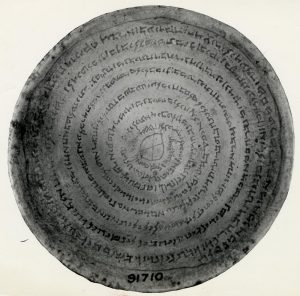
One of the most striking examples comes from late antique Mesopotamia: the Aramaic incantation bowl. These were often ordinary-looking ceramic bowls, not royal treasures or monumental temple objects. Their power lay in the writing placed upon them. Many were inscribed with spiraling texts that moved across the interior surface of the bowl, sometimes from the rim toward the center, sometimes in other arrangements depending on the object and tradition. The inscriptions could call upon divine names, angels, supernatural beings, or ritual formulas to protect a person, a household, or a family.
In many cases, these bowls were protective. They were meant to guard against demons, illness, misfortune, or harmful forces believed to threaten daily life. This makes them deeply human objects. They do not speak only of fear in the abstract. They speak of households, bedrooms, thresholds, children, illness, anxiety, and the fragile hope that danger could be contained before it entered the body or the home.
Their form matters. A bowl is a hollow object. It can receive, enclose, and define an interior space. When an incantation was written inside such a form, the bowl could become more than a surface for text. It could become a symbolic trap, a protective enclosure, or a ritual boundary. The writing did not float freely. It was gathered into the curved body of the vessel.
This gives the incantation bowl a different logic from the libation vessel, but the two still belong to the same larger world of ritual materiality. The libation vessel releases liquid toward a sacred destination. The incantation bowl, by contrast, often attempts to hold danger in place, redirect it, or prevent it from crossing into the human sphere. One vessel offers outward. Another contains inward. Both depend on the belief that material form can help organize invisible relations.
The British Museum preserves several such bowls from Iraq and historic Mesopotamia, dated broadly to the late or post-Sasanian period. Some are wheel-made pottery bowls with Aramaic inscriptions written in spirals. Museum records classify their inscriptions as magical, and one example is described as a counter-charm that seeks not only the well-being of the client but also severe punishment for an enemy. This is an important detail, because it shows that ancient protective practice could sometimes move toward the edge of aggression. The bowl was not always a gentle object. In certain cases, it became a vessel of reversal, retaliation, or binding.
This is where the idea of “forbidden” or “dark” ritual finds a careful historical footing. There is evidence for ritual practices that modern readers might associate with curse, counter-magic, or black magic. But the article should not treat them as theatrical evil. It is more accurate, and more powerful, to describe them as part of a world where fear itself had ritual form. People feared demons, hostile magic, sickness, enemies, bad fortune, and unseen forces. In response, they created objects that could name, trap, repel, reverse, or contain what they feared.
Ancient Mesopotamian anti-witchcraft rituals also belong to this shadowed edge of ritual life. These were not simply rituals for harming others. Many were designed to protect a victim believed to be suffering from witchcraft. The purpose was to undo harmful magic, purify the patient, and restore the person from a state of danger back toward life and safety. In some anti-witchcraft ceremonies, offerings were presented, spaces were purified, prayers and incantations were spoken, and beer could be poured as a libation.
This detail is especially valuable because it brings the act of pouring back into the discussion. Even in rituals against witchcraft, liquid could still play a role within a structured sacred response. Beer, water, or other substances were not merely practical materials. They belonged to the ritual grammar of purification, offering, reversal, and restoration. The same world that poured to honor the gods could also pour while confronting fear.
Here the logic of pouring becomes more complex. Liquid can soothe, but it can also cleanse. It can honor, but it can also mark a boundary. It can nourish the dead, but it can also help restore the endangered living. In anti-witchcraft contexts, the poured substance may belong to a larger sequence intended to separate the victim from harm and return disorder to its source. The vessel, again, is not a passive object. It participates in the attempt to reorder a troubled world.
Egypt gives another related example through execration practices. In these rituals, the names of enemies could be written on pottery, figurines, or other objects, which were then ritually broken, buried, or otherwise destroyed. The purpose was not ordinary writing, but symbolic defeat. To inscribe the enemy’s name was to make that enemy ritually present. To break the object was to enact domination over the threat.
Although execration objects are not the same as libation vessels, they belong to the same broader history of ritual containers, surfaces, and material action. A bowl, pot, shard, or figurine could carry a name. Once inscribed, the object became more than clay or stone. It became a ritual substitute for the enemy or danger it represented. Destroying it was not seen as an empty gesture, but as an action performed upon the symbolic body of the threat.
This shadowed material logic helps us understand ancient ritual more honestly. The sacred was not always soft, serene, or beautiful. It could also be urgent, defensive, and severe. People did not only approach the divine with gratitude. They also approached unseen powers with fear. They did not only ask for blessing. They asked for protection. They did not only bring offerings to maintain harmony. They also used ritual objects to confront what they believed could destroy harmony.
For this reason, the darker side of ritual bowls should not be added merely to create suspense. It matters because it reveals something true about ancient life. The same civilizations that built temples, carved offering tables, and dedicated libation goblets also lived with anxiety about illness, demons, enemies, curses, and spiritual attack. Their ritual objects were shaped not only by devotion, but also by vulnerability.
A libation vessel teaches us about release. An offering table teaches us about nourishment and continuity. An incantation bowl teaches us about containment. An execration vessel or shard teaches us about symbolic destruction. Together, these objects show that ancient ritual was not only a language of giving. It was also a language of guarding, reversing, binding, and surviving.
The Sacred Logic of Pouring
After moving through Mesopotamian libation, Egyptian funerary vessels, and the shadowed world of protective bowls and curse-related objects, one pattern becomes clear: pouring was never only about the movement of liquid. It was about the movement of meaning.
A liquid begins as something material. It can be drawn from a river, pressed from fruit, brewed from grain, taken from an animal, or prepared by human labor. Before ritual begins, it may belong to daily life. Water cleans the body and satisfies thirst. Milk nourishes the young. Beer and wine belong to food, feast, hospitality, and pleasure. Oil protects, perfumes, preserves, or anoints. These substances are ordinary because they are necessary. They belong to survival.
Ritual does not erase that ordinary life. Instead, it redirects it.
When water is poured before a god, over an offering table, into the earth, beside a tomb, or within a protective ceremony, it is no longer only water in the everyday sense. It has entered a new relationship. It may cleanse, honor, nourish, cool, awaken, seal, or separate. The substance remains physical, but its status changes. This is one of the deepest powers of ritual: it takes what the world already contains and places it inside a sacred order.
The vessel makes this change visible.
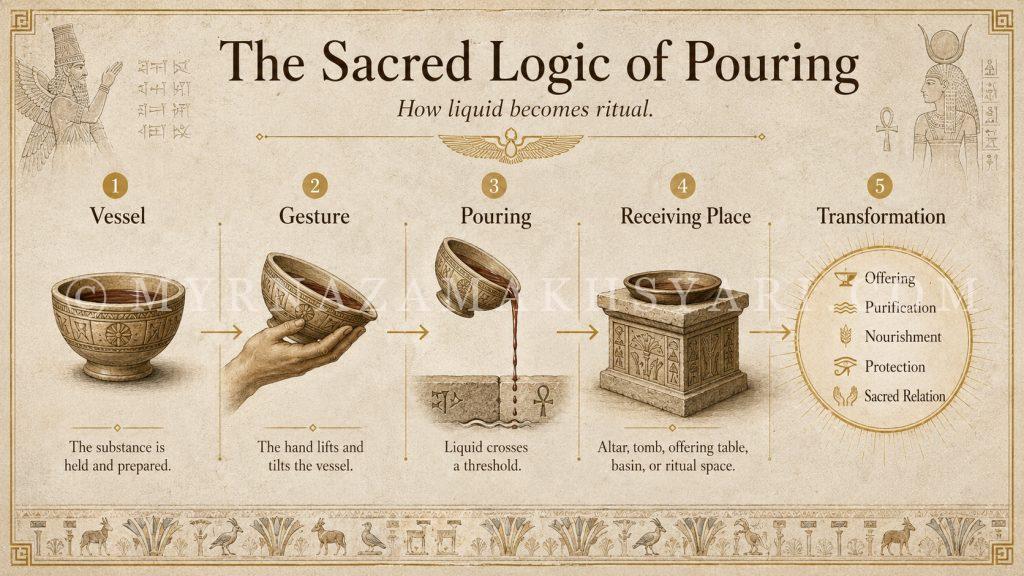
A bowl or goblet holds the substance before the moment of transformation. It keeps the liquid close to the human hand. It allows preparation, waiting, and intention. Then, when the vessel is lifted and tilted, the liquid leaves human possession and enters another field of meaning. This movement may seem small, but it carries a complete ritual structure. There is preparation, containment, direction, release, and reception.
That structure appears again and again across ancient cultures. In Mesopotamia, the libation vessel could help a worshiper approach divine presence. In Egypt, ritual vessels and offering tables could help renew the dead and sustain the bond between tomb and living community. In protective and anti-witchcraft contexts, bowls and vessels could participate in rituals meant to reverse harm or contain invisible danger. The purposes differ, but the underlying logic remains related: material substance is guided through form so that a human concern can be addressed ritually.
This is why liquid was so powerful. It is never fully still. Even when stored, it suggests movement. It can flow through a spout, spread over stone, sink into soil, wash across a surface, vanish into a crack, or evaporate into air. Unlike a carved statue or a placed loaf of bread, a poured liquid completes its offering by changing shape and location. Its disappearance is not a failure. In ritual terms, disappearance may be part of its work.
The ancient world understood this very well. A liquid offering could be meaningful precisely because it did not remain. It crossed a boundary and became difficult to recover. Once poured, it could not be gathered back into the vessel in the same pure form. It had been given. The act was completed through release.
This is different from simply placing an object before a sacred image. A placed object remains available to sight. It can be counted, moved, stored, or removed. A poured liquid belongs to another kind of offering. It is closer to breath, smoke, sound, and fragrance—things that appear through action and then leave the visible world. Such offerings ask the observer to trust the gesture, not only the remaining object.
This helps explain why libation is so closely connected to the body. Pouring must be performed. It requires the hand, the wrist, the eye, and the controlled movement of the vessel. The person who pours does not merely deliver a substance. The person becomes part of the offering’s path. The human body guides the liquid from the realm of use into the realm of dedication.
The receiving place is equally important. Liquid poured randomly is a spill. Liquid poured ritually has a destination. It may fall onto an altar, basin, platform, tomb, threshold, offering table, foundation, or earth prepared for the act. The surface that receives the liquid helps define what the act means. A tomb chapel, a temple platform, a household threshold, and a riverbank are not interchangeable spaces. Each gives the liquid a different ritual direction.
This is why vessels, gestures, and places must be read together. A libation goblet in a museum is only one part of the story. A cylinder seal showing a worshiper pouring before a seated god gives us another part. An Egyptian offering table with a channel or carved food imagery gives us yet another. Together, they remind us that ancient ritual was a system, not a random collection of beautiful objects.
In this system, the vessel held potential. The gesture activated it. The place received it. The substance carried the meaning across.
The same logic can also help us understand the darker or more defensive side of ritual bowls. When a bowl was inscribed with protective words or used within an anti-witchcraft framework, its purpose was not always release. Sometimes the goal was containment, reversal, or boundary-making. Yet even there, the vessel remained important because it gave shape to an invisible concern. Fear needed a form. Harm needed a name. Danger needed a place where it could be addressed.
This is one of the reasons ancient ritual objects can feel so intimate. They show that human beings did not only build sacred systems around triumph, kingship, and grandeur. They built them around thirst, grief, illness, fear, memory, and need. The same hand that poured before a god may also have poured for the dead, washed a ritual surface, or sought protection from unseen harm. Ritual life was woven from both reverence and vulnerability.
A vessel therefore becomes more than an archaeological object. It becomes evidence of how ancient people handled uncertainty. They could not control death, weather, illness, divine will, or invisible danger. But they could prepare a vessel. They could speak words. They could pour water. They could bring beer, milk, oil, or wine to the place where human life met forces greater than itself.
The sacred logic of pouring rests on this quiet confidence: matter can carry meaning when it is placed within the right relationship. Water is not only water when it is drawn, held, spoken over, and poured in a ritual setting. Milk is not only nourishment when it becomes part of a ceremony of rebirth. Beer is not only drink when it is offered to divine powers or used within a ritual of reversal. Oil is not only a substance when it marks consecration or care.
Ritual does not remove these materials from the world. It deepens their place within it.
This is why libation vessels and ritual bowls deserve to be seen as more than decorative remains. They are small archives of ancient action. Their rims, hollows, spouts, inscriptions, and surfaces preserve traces of how people once imagined the passage between body and cosmos. They show us that sacred life was not always built through height, scale, or monumentality. Sometimes it was built through the careful handling of something that could be spilled.
The logic is simple enough for a child to see, yet deep enough to hold a civilization’s theology: something is gathered, held, lifted, and released. What leaves the hand enters another order.
This is the essence of pouring as ritual. It transforms possession into offering, substance into relation, and movement into meaning.
The Theology of Release
To pour is to accept that meaning does not always remain in the hand.
This is the final lesson of libation vessels, ritual bowls, offering tables, and vessels of protection. They all begin with containment. A liquid is gathered, prepared, and held. A bowl receives it. A goblet preserves it. A spouted vessel directs it. A ritual table waits for it. Yet the purpose of the act is rarely fulfilled by keeping the substance still. The meaning becomes complete when something is released, redirected, or ritually transformed.
This is why ancient vessels should not be understood only as containers. They were instruments of passage. They gave shape to the moment before change. They allowed water, milk, beer, oil, or wine to be held close to the body before entering another order of meaning. In this brief interval between holding and pouring, the vessel became a threshold.
The ancient world understood thresholds with great seriousness. A temple doorway, a tomb entrance, a household boundary, a ritual platform, an altar, and a grave were not merely physical places. They marked transitions between ordinary and sacred space, between the living and the dead, between the protected interior and the uncertain outside, between human need and divine presence. A vessel could create a similar threshold in miniature. Its rim separated inside from outside. Its hollow protected the substance before the appointed moment. Its shape prepared the hand for action.
When the liquid finally left the vessel, it did not simply disappear. It crossed into relation.
This relation could take many forms. In Mesopotamia, pouring could become an offering before the gods, a gesture that helped maintain the bond between human society and divine order. In Egypt, pouring could nourish the dead, activate an offering table, or belong to rituals of restoration and renewed life. In protective and anti-witchcraft contexts, bowls and vessels could help give form to fear, danger, reversal, and containment. These uses were different, yet they shared one deep assumption: matter could participate in sacred order when handled through the right action.
The vessel teaches this quietly. It does not command attention like a palace wall, a colossal statue, or a towering temple. It stands closer to the scale of the hand. It belongs to the intimate world of touch, preparation, pouring, washing, feeding, protecting, and remembering. For this reason, ritual vessels may reveal ancient religion at its most human. They show not only what civilizations believed, but how belief moved through daily materials and bodily gestures.
A vessel also reminds us that the sacred was not always far away. It could be approached through water. It could pass through milk. It could be marked by beer, oil, wine, incense, bread, stone, clay, and carved surfaces. Ancient ritual did not always require the separation of the spiritual from the material. On the contrary, it often depended on their meeting. The human hand touched matter so that matter could carry intention beyond the hand.
This gives pouring its emotional depth. To pour is to let go of something prepared. It is to surrender a substance into a place, a presence, or a purpose that exceeds ordinary possession. Once poured, the liquid cannot return unchanged. It spreads across stone, sinks into earth, flows through channels, touches carved offerings, or vanishes from sight. The act cannot be reversed. Its seriousness lies partly in that finality.
This is why pouring can be so powerful as a ritual gesture. It is simple enough for anyone to understand, yet deep enough to carry devotion, grief, gratitude, fear, purification, nourishment, and memory. It does not rely only on words. It speaks through movement. It says that something has been prepared, something has been given, and something has crossed from one state into another.
In this sense, libation vessels and ritual bowls are small archives of ancient trust. They preserve the belief that a carefully performed act could matter beyond the visible moment. A stream of water might last only seconds, but the relationship it served could be imagined as enduring beyond death. A bowl inscribed with protective words might be hidden beneath a threshold, but its purpose was to guard the living space from unseen harm. A goblet dedicated by a ruler might remain as stone, inscription, and image, but its deeper life once belonged to ritual motion.
The surviving object is therefore both evidence and absence. It shows us the vessel, but not the hand that held it. It shows us the material, but not the exact voice that spoke beside it. It preserves the form, but not the full atmosphere of the temple, tomb, house, or ritual chamber in which it once worked. Yet this absence does not make the object mute. It invites us to read the vessel as a trace of action.
What remains in the museum is the stillness after movement.
That stillness has its own dignity. Behind glass, the vessel no longer pours, yet it continues to teach. It teaches that ancient people did not see matter as empty. They shaped stone, clay, metal, and glaze into instruments of relationship. They carved names, gods, serpents, offerings, and signs onto surfaces that once entered ritual life. They understood that a bowl could hold more than liquid, and that pouring could express more than the transfer of substance.
It could express dependence. It could express care. It could express surrender. It could express the wish to nourish the dead, honor the gods, cleanse the body, protect the household, or contain fear before it crossed the threshold.
This is the sacred logic of pouring.
A vessel gathers what the hand cannot hold alone. A ritual gives that holding a purpose. The moment of release changes the substance’s meaning. What was once ordinary becomes dedicated. What was once private becomes relational. What was once contained enters movement.
Perhaps this is why these objects still speak to us. They come from civilizations separated from us by language, time, landscape, and belief, yet their gestures remain understandable. We still know what it means to hold something carefully. We still know what it means to offer, to wash, to feed, to protect, to remember, and to let go. The ancient vessel stands at the meeting point of all these acts.
It is a small object with a large memory.
To study libation vessels and ritual bowls is therefore to study more than ancient religion. It is to study how human beings gave shape to invisible concerns. It is to see how fear, devotion, grief, hope, and reverence entered the material world. It is to understand that sacred order was not built only by kings, priests, monuments, or myths, but also by hands that lifted vessels and poured liquid into meaning.
Long after the liquid vanished, the vessel remained.
And in that remaining, we can still sense the moment when something was held, offered, and released.
Selected Sources
National Library of Israel — Incantation Bowls / Magic Bowls from Babylon
This reference supports the discussion of incantation bowls as protective objects. The National Library of Israel describes these bowls as clay vessels covered with blessings, curses, magical formulas, and sometimes images, often buried under house floors to protect owners, families, and property from malicious demons.
University of Würzburg — Corpus of Mesopotamian Anti-witchcraft Rituals Online
This scholarly project supports the article’s cautious discussion of anti-witchcraft rituals. It describes ritual elements such as purification, prayers, incantations, offerings, substitute figurines, and a libation of beer within anti-witchcraft ceremonies.
Britannica — Execration Texts
This source supports the brief Egyptian comparison in the “shadow edge” section. It describes Egyptian execration texts as inscriptions of enemies’ names on pottery that was ceremonially broken to invoke a curse.
Further Research Candidates
For a deeper version of the article or a later book chapter, the following references may be useful: Sébastien Rey’s The Temple of Ningirsu: The Culture of the Sacred in Mesopotamia; Ariane Thomas and Laurent Colonna d’Istria’s study on the temple of Ningishzida at Girsu; and museum catalogues on Mesopotamian water, temple culture, and Neo-Sumerian ritual objects.